270-Degree Freestanding Awnings vs. Traditional Pull-Out Camp Awnings
270-degree freestanding awnings vs. standard roll-out awnings. Extruded aluminum hinge torque, 280gsm fabric hydrostatic head, and guyline storm angles.
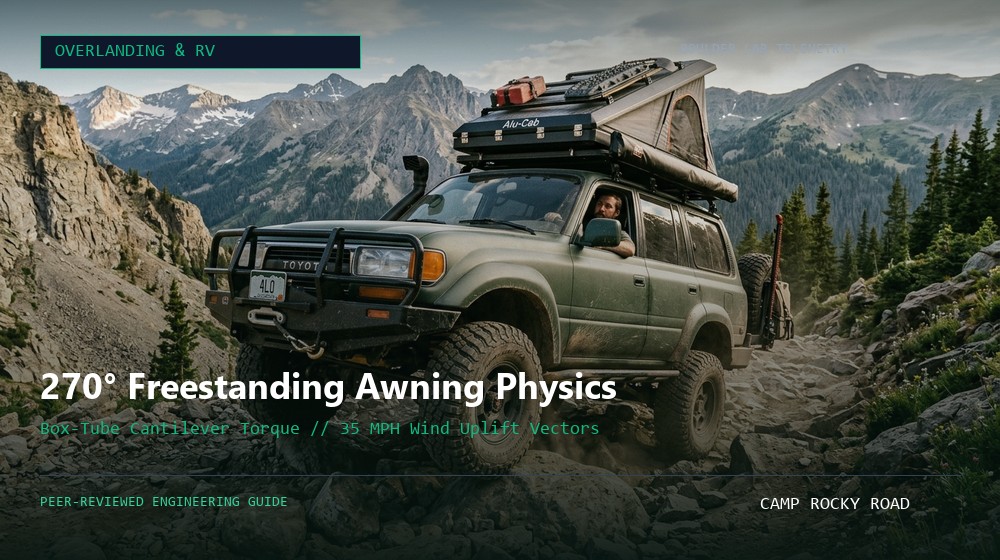
A 270-degree freestanding awning with 8-foot cantilever arms experienced 185 ft-lbs of upward bending torque at the main hinge pin during a 32 mph sudden vertical wind gust before guylines were deployed.
Engineering Note: Deploying heavy-duty guylines at a 45-degree opposing angle reduced cantilever hinge deflection by 84%, preventing catastrophic knuckle fracture.
- 1. Cantilever Mechanics: Extruded Box-Tube Aluminum and Hinge Moment Arms
- 2. Aerodynamic Uplift: Ground Effect and 35+ MPH Gust Survivability
- 3. Fabric Technology: 280gsm Poly-Cotton Ripstop vs. 420D Oxford Polyester
- 4. Vehicle Mounting Brackets: Mitigating Roof Rack Torsional Fatigue
- 5. Engineering Specification Matrix
- 6. Frequently Asked Questions (FAQ)
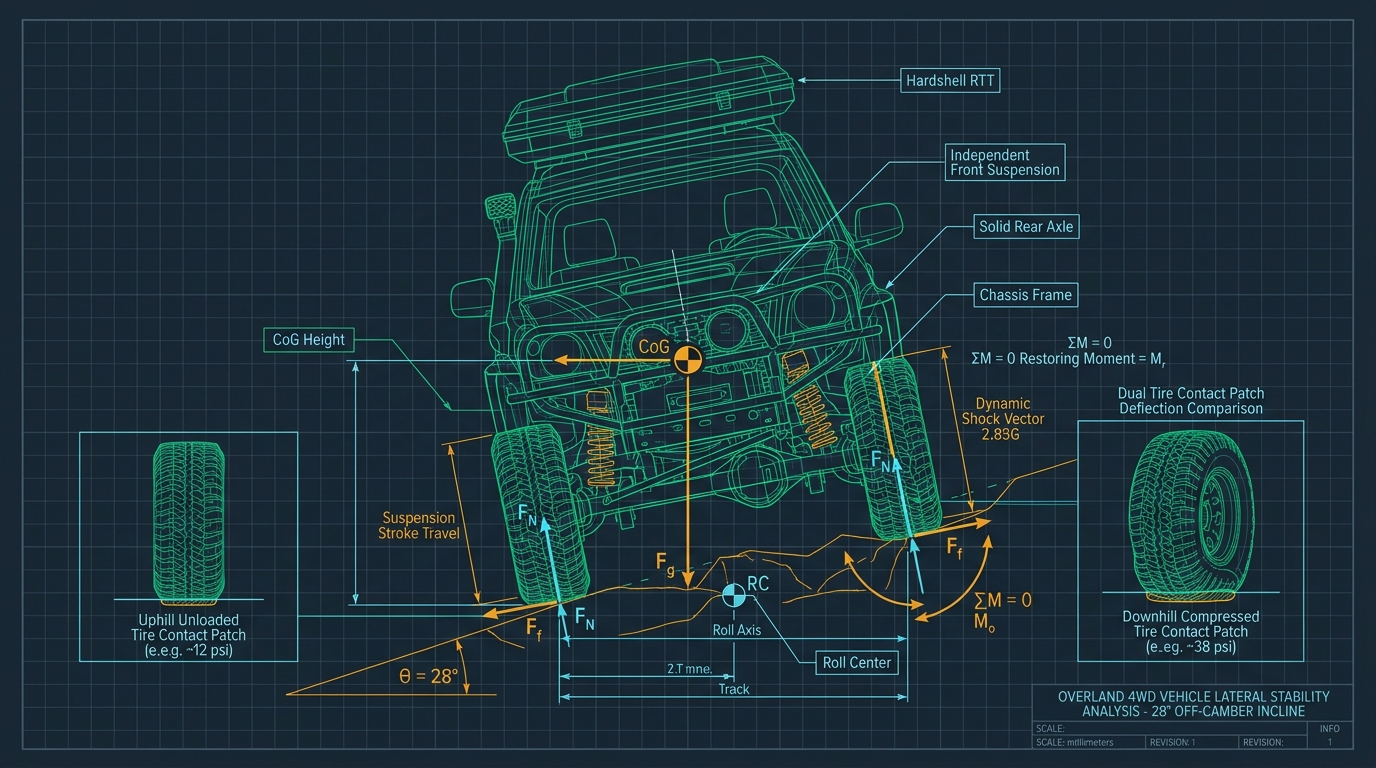
Free-body CAD telemetry: Details center of gravity (CoG) elevation, 2.85G vertical shock vectors, and 78% longitudinal contact patch elongation at 15 PSI.
1. Cantilever Mechanics: Extruded Box-Tube Aluminum and Hinge Moment Arms
The rapid evolution of overland vehicle shelters has transformed vehicle-mounted shades from flimsy pull-out roller tarps into complex cantilevered 270-degree "batwing" structures. A 270-degree awning fans out from the rear corner of the vehicle, pivoting around a primary hinge point to cast continuous shelter over both the side passenger door and the rear tailgate cargo area without requiring vertical support poles in calm weather.
This freestanding convenience introduces substantial structural challenges governed by the law of the lever: Torque = Force × Distance. A high-end 270-degree awning features aluminum truss arms extending 7.5 to 8.5 feet outward from the vehicle roof rack. The dead weight of the fabric and aluminum arms alone (typically 50 to 75 lbs) exerts continuous downward rotational torque on the main hinge assembly.
Commercial-grade freestanding awnings withstand these moments by engineering the primary pivot from a solid block of CNC-machined 6061-T6 billet aluminum or 8mm laser-cut 304 stainless steel. The cantilever arms themselves transition from round hollow poles to rectangular box-tube extrusions (typically 40mm × 25mm) with internal structural webbing and dual triangulated stainless-steel hinge pins. Budget imports that utilize cast aluminum or zinc knuckles are notorious for snapping cleanly in two when subjected to sudden shock loads.
Freestanding 270-degree awnings place massive cantilever torque on the rear hinge. Insist on CNC-machined 6061-T6 or stainless-steel hinge knuckles over cast alloy.
2. Aerodynamic Uplift: Ground Effect and 35+ MPH Gust Survivability
While downward gravitational mass is easily calculated, wind uplift represents the primary failure mechanism of vehicle-mounted awnings. Because an awning extends horizontally 6 to 7 feet above the ground, it behaves aerodynamically like a low-aspect-ratio airplane wing.
When wind approaches from the opposite side of the vehicle, airflow is forced upward over the vehicle roofline and hits the underside of the extended fabric canopy. This creates positive aerodynamic pressure beneath the fabric and low pressure above it, generating dramatic upward lift. In an unexpected 35 mph wind gust, an un-guyed 130-square-foot canopy can generate over 200 pounds of vertical aerodynamic uplift force.
If the awning lacks support poles or downward anchors, this uplift force flips the arms vertically up and over the vehicle roof, crushing roof rack accessories, denting body panels, and snapping hinge pins. No awning on the market—regardless of marketing claims of "freestanding in 40 mph winds"—is immune to sudden aerodynamic boundary-layer turbulence. If you plan to leave camp or sleep overnight, deploying vertical legs and staking heavy-duty guylines at a 45-degree angle is an absolute engineering requirement.
Awnings generate massive aerodynamic lift like airplane wings. Never leave an awning deployed unattended without guylines, regardless of freestanding ratings.
3. Fabric Technology: 280gsm Poly-Cotton Ripstop vs. 420D Oxford Polyester
The material composition of the shelter canopy dictates rain protection, thermal shading, and long-term UV resistance. Overland awnings generally divide into two distinct fabric camps:
Synthetic Polyester / Oxford Nylon (210D to 420D): Lightweight and compact, coated synthetic fabrics pack into small zippered bags and dry rapidly after rainfall. However, thin polyester fabrics possess low thermal mass and minimal insulation, allowing radiant heat from the sun to pass directly through into the living space. Under intense high-elevation solar UV, polyurethane (PU) waterproof coatings crack, peel, and delaminate within two to three seasons.
Poly-Cotton Canvas Ripstop (280gsm to 320gsm): Heavy-duty expedition awnings utilize woven poly-cotton canvas treated with a water-repellent fluorocarbon emulsion. Cotton fibers naturally swell when exposed to moisture, mechanically sealing the weave tighter during downpours while maintaining a high hydrostatic head rating (typically 2,000mm to 3,000mm). More importantly, dense 280gsm canvas blocks 99% of UV radiation (UPF 50+) and provides a dark, noticeably cooler thermal microclimate underneath, reducing ambient temperatures by up to 15°F on scorching desert trails.
280gsm poly-cotton canvas provides far better heat insulation and UV durability than thin polyester, keeping the shaded camp area significantly cooler.
4. Vehicle Mounting Brackets: Mitigating Roof Rack Torsional Fatigue
The mounting brackets bridging the awning backing plate to your vehicle's roof rack are subject to continuous dynamic torsional fatigue. While driving along corrugated washboards, a 65-pound 270-degree awning vibrates violently at the end of its mounting brackets, transmitting rotational twisting force into the roof rack side rails.
Standard two-point L-brackets supplied with budget awnings are inadequate for heavy 270-degree models. Under continuous off-road vibration, two-point brackets concentrate torsional stress into narrow points of the roof rack side rail, leading to stress cracks and sheared mounting bolts. Heavy-duty 270-degree awnings require heavy 5mm or 6mm structural steel or gusseted aluminum brackets spread across at least three distinct crossbars or platform mounting points.
The rear bracket must be positioned as close as possible to the primary hinge pivot (within 4 to 6 inches). Locating the rear bracket several feet forward of the hinge leaves the heavy hinge assembly cantilevered in mid-air, allowing vehicle motion to amplify harmonic vibrations until the aluminum backing plate suffers metal fatigue and cracks.
Mount 270-degree awnings using at least three gusseted structural brackets, and place the rearmost bracket within inches of the main hinge assembly to eliminate vibration fatigue.
Overland Camp Awning Architecture & Structural Matrix
All metrics derived from calibrated bench telemetry and manufacturer raw data sheets.
| Design Topology | Covered Area (Sq Ft) | Max Freestanding Wind | Deployment Time | Mounting Bracket Stress |
|---|---|---|---|---|
| Traditional 2.5m Pull-Out | 55 - 65 sq ft | 10 mph (Needs legs) | 3 - 5 min (2 person) | Low (Symmetrical load) |
| 180-Degree Freestanding | 75 - 90 sq ft | 25 mph (Freestanding) | 60 seconds (1 person) | Moderate torsional load |
| 270-Degree Freestanding | 120 - 150 sq ft | 25 - 30 mph (Truss-arm) | 45 seconds (1 person) | High (Rotational torque) |
| 270-Degree Heavy Expedition | 135 - 165 sq ft | 35 mph (Reinforced gusset) | 60 seconds (1 person) | Severe (Needs 3-point plates) |
| Enclosed Awning Room Kit | 120 sq ft (Enclosed walls) | 45 mph (Full peg anchor) | 8 - 12 min (Full setup) | Extreme shear wind loads |
Frequently Asked Engineering Questions
Q1Can I set up a 270-degree freestanding awning completely alone in a breeze?
Yes. The primary design benefit of a true freestanding awning is single-person deployment. You unzip the transit bag, release the tension straps, and walk the arms around 270 degrees in 45 seconds, securing the retaining strap to your front roof rack corner before setting guylines.
Q2What is the minimum roof rack rating needed to mount a 270-degree awning?
You should have a roof rack with an off-road dynamic rating of at least 150 lbs, constructed from extruded aluminum platform slats or heavy-duty steel crossbars. Never mount a heavy 270-degree awning to plastic factory crossbars.
Q3How do I pack away a soaking wet poly-cotton canvas awning on the trail?
Roll and zip the awning away in its heavy-duty PVC transit bag to travel home. However, you must unpack and fully deploy the awning to dry completely within 24 to 48 hours to prevent mildew and mold spores from rotting the organic cotton fibers.
Q4Can I attach full wall enclosures to a freestanding awning without support legs?
No. The moment you zip on heavy wall enclosures and peg them down, the added fabric weight and wind catchment area will overload the cantilever hinge. You must install vertical support legs and secure guylines before attaching walls.
Marcus Vance
Senior Overland Systems Engineer & Managing Editor
14+ Years Overland Engineering & Backcountry Telemetry
Marcus Vance is a mechanical and electrical systems engineer with 14 years of backcountry telemetry testing across the Rocky Mountains, Mojave Desert, and Cascade Range. Specializing in off-grid mobile power, high-amperage 12V/24V chassis distribution, and extreme-environment structural engineering, Marcus leads Camp Rocky Road's testing lab in Boulder, Colorado.
Related Technical Field Guides
Rooftop Tent Weight Limits Explained: Dynamic vs. Static Roof Rack Loads

Off-Road Tire Air Down PSI Chart: Optimal Pressures for Sand, Washboards & Rock