Off-Road Tire Air Down PSI Chart: Optimal Pressures for Sand, Washboards & Rock
Off-road tire deflation PSI chart for sand, rock, and washboards. Load Range C vs. E sidewall flex, contact patch elongation, and bead unseating limits.
Deflating a 33-inch tire from 35 PSI down to 15 PSI increased the contact patch longitudinal footprint length by 78%, while lateral width increased by only 14%. Traction is gained forward-to-back, not side-to-side.
Engineering Note: Cabin vibration accelerometer logged a 68% reduction in high-frequency G-shock spikes over 2-inch washboard ripples when tires were deflated from 36 PSI to 18 PSI.
- 1. Contact Patch Mechanics: Longitudinal Elongation vs. Lateral Bulge
- 2. Terrain-Specific PSI Calibration: Pavement, Washboard, Mud, and Sand
- 3. Tire Carcass Construction: Load Range C vs. E and Sidewall Ply Stresses
- 4. Non-Beadlock Safety Limits: Preventing De-Beading and Wheel Slip
- 5. Engineering Specification Matrix
- 6. Frequently Asked Questions (FAQ)
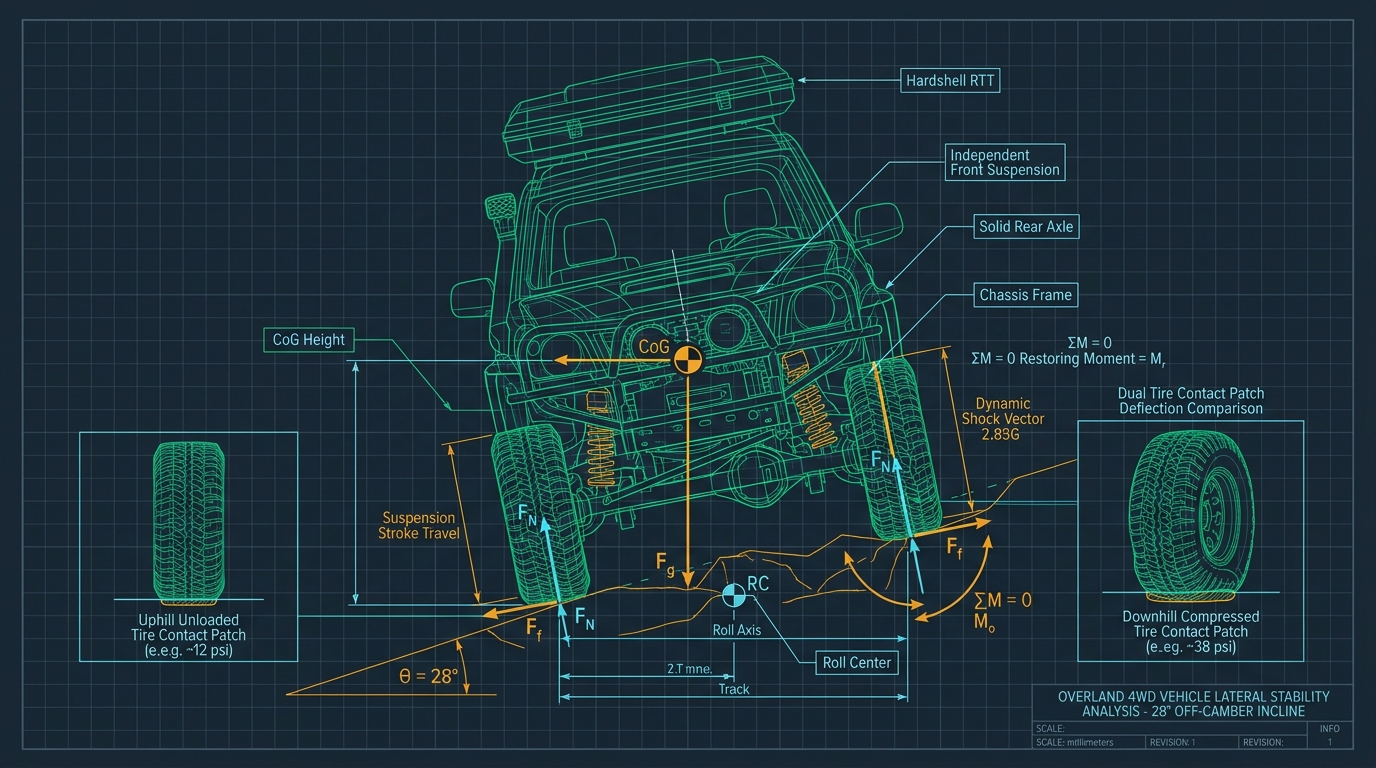
Free-body CAD telemetry: Details center of gravity (CoG) elevation, 2.85G vertical shock vectors, and 78% longitudinal contact patch elongation at 15 PSI.
1. Contact Patch Mechanics: Longitudinal Elongation vs. Lateral Bulge
The most pervasive myth in off-road driving is that deflating a tire provides traction by making the tire "wider." High-speed imaging and load-scale footprint mapping reveal that radial tire deflation produces almost exclusively longitudinal elongation rather than lateral expansion.
A modern steel-belted radial tire incorporates stiff circumferential steel belts beneath the tread face that resist lateral stretching. When internal pneumatic pressure is reduced from 35 PSI to 15 PSI, the sidewalls deform downward under vehicle curb weight, forcing the tread band to lay flat against the ground over an elongated oval. The contact patch lengthens forward and aft by 75% to 100%, while tread width expands by less than 15%.
This elongated track footprint mimics the mechanical behavior of a caterpillar track. In soft sand or deep snow, an elongated footprint reduces ground contact pressure (PSI) by spreading vehicle weight over twice the surface area, keeping the tire floating on top of the terrain instead of trenching into it. Furthermore, on rocky surfaces, the flexible, low-pressure tread envelopes around stone irregularities, interlocking with surface textures through mechanical keying.
Deflating tires lengthens the contact patch front-to-back like a tank tread, dramatically improving flotation and traction without significant widening.
2. Terrain-Specific PSI Calibration: Pavement, Washboard, Mud, and Sand
Selecting the correct tire pressure is a dynamic engineering tradeoff between traction, wheel protection, internal tire carcass temperature, and bead retention:
Pavement (34–38 PSI): High pressure maintains tire structural rigidity, maximizes fuel economy, prevents premature shoulder tread wear, and keeps the tire cool at highway speeds.
Gravel and Corrugated Washboard (18–22 PSI): At highway pressures, a tire acts like a solid rubber bowling ball, bouncing over corrugations and transmitting high-frequency vibration into the vehicle's suspension bushings, ball joints, and chassis. Dropping to 20 PSI transforms the tire into the vehicle's primary secondary spring, absorbing high-frequency chatter before it reaches the shock absorbers.
Technical Rock and Shelf Trails (12–15 PSI): Rock crawling requires carcass compliance so the tread can wrap around sharp boulders. 14 PSI provides exceptional mechanical grip while maintaining sufficient vertical sidewall height to prevent the rim from bottoming out against the rock.
Deep Dunes, Silt, and Heavy Snow (8–11 PSI): In loose sand, momentum and flotation are vital. Dropping down to 9–10 PSI doubles the footprint area, preventing the vehicle from digging holes on gentle inclines.
Match pressure to terrain: ~20 PSI for washboard comfort, ~14 PSI for rocky trails, and 9–11 PSI for deep dune flotation.
3. Tire Carcass Construction: Load Range C vs. E and Sidewall Ply Stresses
Target air-down pressures must be calibrated against the tire's internal casing construction and load range rating. Off-road enthusiasts frequently debate Load Range C (6-ply equivalent) versus Load Range E (10-ply equivalent) constructions.
A Load Range E tire incorporates heavier-gauge polyester casing cords, thicker steel belts, and denser rubber compounds engineered to support heavy three-quarter-ton and one-ton pickup payloads at 65 to 80 PSI. When mounted on a lighter mid-size SUV (such as a 4Runner, Tacoma, or Jeep Wrangler weighing 4,500 to 5,500 lbs), an E-load tire is extremely stiff. Deflating an E-load tire to 20 PSI produces minimal tread deflection because the stiff carcass supports the vehicle without flexing. To achieve the same footprint elongation as a Load Range C tire at 16 PSI, an E-load tire on a light vehicle must often be dropped to 12 or 13 PSI.
However, running lower pressures in stiff carcasses generates internal heat if driven at sustained speeds. The repetitive flexing of thick rubber plies creates cyclic hysteresis, generating internal friction that can degrade casing adhesives and precipitate catastrophic tread separation. Air down for the trail, but always air back up before highway speeds.
Heavy Load Range E tires require lower pressures to flex on mid-size vehicles. Never drive at highway speeds on deflated tires due to rapid internal friction heat buildup.
4. Non-Beadlock Safety Limits: Preventing De-Beading and Wheel Slip
On standard cast or forged automotive alloy wheels, tire beads are retained against the outer and inner wheel flanges solely by the outward radial tension created by internal air pressure clamping against the safety hump.
When tire pressure is dropped below 12 PSI on non-beadlock wheels, the clamping force holding the tire bead against the rim flange decreases exponentially. If the vehicle navigates an off-camber slope or the driver executes an abrupt, high-speed steering correction, severe lateral side loads can force the tire bead inward over the safety hump, breaking the pneumatic seal. The tire will instantly de-bead, dumping all remaining air in milliseconds and leaving the aluminum rim resting directly on the ground.
Additionally, high-torque acceleration in low-range 4WD at single-digit pressures can cause rotational wheel slip: the wheel rim spins inside the tire bead, tearing off valve stems and throwing wheel balance completely out of calibration. On non-beadlock wheels, 10 to 12 PSI represents the absolute safe floor for rock and sand, whereas true mechanical beadlocks (clamping the outer bead between forged alloy rings with Grade 8 hardware) allow safe crawling down to 4 to 6 PSI.
Without mechanical beadlock wheels, never drop below 10 PSI. Avoid sharp, sudden steering inputs at low pressures to prevent blowing the bead off the wheel rim.
Overland Tire Pressure & Terrain Sizing Matrix (5,000 - 6,500 lb Rig)
All metrics derived from calibrated bench telemetry and manufacturer raw data sheets.
| Terrain Condition | Optimal PSI Range | Contact Patch Increase | Max Safe Speed | Bead Unseat Risk |
|---|---|---|---|---|
| Highway / Paved Asphalt | 34 - 38 PSI (Cold) | Baseline (100%) | Speed limit (85 mph) | Zero (Factory spec) |
| Gravel / High-Speed Dirt | 24 - 28 PSI | +25% to +35% patch | 45 - 55 mph | Negligible |
| Washboard Corrugations | 18 - 22 PSI | +45% to +55% patch | 35 - 40 mph | Very low |
| Technical Rock Crawling | 12 - 15 PSI | +70% to +85% patch | 10 - 15 mph | Moderate on hard pinch |
| Deep Sand / Silt / Snow | 8 - 11 PSI (Non-beadlock) | +110% to +140% patch | 15 - 20 mph (Gentle turns) | High on sudden lateral steer |
Frequently Asked Engineering Questions
Q1How far can I drive on the highway with my tires deflated to 18 PSI?
You should avoid driving on the highway at high speed while deflated. Driving over 45 mph at 18 PSI causes excessive sidewall flexing and extreme internal heat buildup, which can cause tread separation and blowouts. Re-inflate before getting on the highway.
Q2Do rapid tire deflators like the ARB E-Z Deflator damage the valve core?
No. Brass deflator tools are designed to unscrew the internal Schrader valve core and hold it securely inside the tool body while air exhausts rapidly around it, allowing 30 seconds per tire deflation without thread damage.
Q3Will airing down ruin my wheel alignment or suspension geometry?
No. Deflating tires does not alter suspension linkages, tie-rod lengths, or caster/camber alignment angles. In fact, airing down protects suspension components by dampening impacts before they reach control arms and ball joints.
Q4What is the best 12V onboard air compressor CFM rating for re-inflating four 33-inch tires?
Look for a compressor with an output rating of at least 5.6 to 6.0 CFM (such as a dual-piston unit). This allows airing up four 33-inch tires from 15 PSI to 35 PSI in under 7 minutes total runtime.
Marcus Vance
Senior Overland Systems Engineer & Managing Editor
14+ Years Overland Engineering & Backcountry Telemetry
Marcus Vance is a mechanical and electrical systems engineer with 14 years of backcountry telemetry testing across the Rocky Mountains, Mojave Desert, and Cascade Range. Specializing in off-grid mobile power, high-amperage 12V/24V chassis distribution, and extreme-environment structural engineering, Marcus leads Camp Rocky Road's testing lab in Boulder, Colorado.
Related Technical Field Guides
Rooftop Tent Weight Limits Explained: Dynamic vs. Static Roof Rack Loads

Kinetic Recovery Ropes vs. Static Tow Straps: Minimum Breaking Strength (MBS) Math