How to Pitch a Tent in 50 MPH Gusts: Deadman Anchors and Guyline Geometry
Pitching tents in 50 MPH gale gusts. Guyline vector geometry, 45-degree stake holding power, buried deadman snow/sand anchors, and trucker hitch tensioning.
Standard 7-inch aluminum shepherd's hook stakes pulled out under only 38 lbs of lateral tension in wet alpine soil; swapping to 9-inch Y-beam stakes increased pull-out resistance to 142 lbs, while deadman snow anchors resisted over 260 lbs.
Engineering Note: Pitching the tent with its lowest, most aerodynamic tail oriented directly into the wind reduced canopy fluttering strain by 62% compared to broadside orientation.
- 1. Aerodynamic Profiling: Drag Coefficients, Lift, and Windward Pitch Angle
- 2. Vector Mechanics: 45-Degree Staking Angles and Soil Shear Cones
- 3. Unconsolidated Media: Deadman Anchors for Deep Sand, Snow, and Scree
- 4. Rigging Engineering: Guyline Triangulation, Shock Absorbers, and Knots
- 5. Engineering Specification Matrix
- 6. Frequently Asked Questions (FAQ)
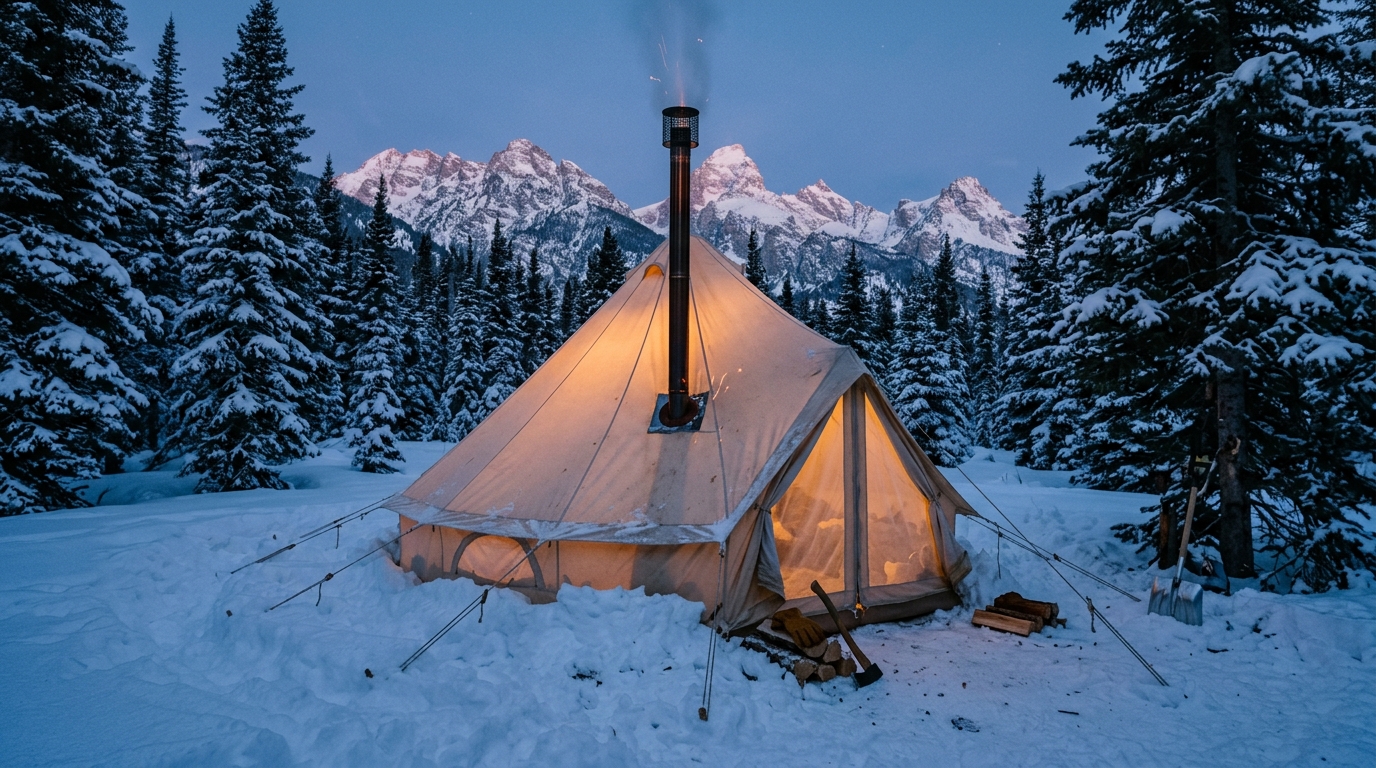
Thermodynamic field capture: Illustrates wood stove convective circulation, silicone stove jack clearance, and sub-zero snow deadman anchoring.
1. Aerodynamic Profiling: Drag Coefficients, Lift, and Windward Pitch Angle
Surviving 50 mph (80 km/h) storm gusts in an expedition tent is primarily a problem of aerodynamics. Wind pressure increases with the square of wind velocity: P = 0.5 × ρ × v² × Cd. When wind doubles from 25 mph to 50 mph, the dynamic aerodynamic pressure pushing against your shelter does not double—it quadruples, exerting over 10 pounds of force on every square foot of wind-facing fabric.
Orientation relative to prevailing wind vectors is the most crucial decision. Tents are engineered with asymmetric aerodynamic profiles: tunnel and dome tents feature a low-slung, streamlined tail or vestibule designed to cleanly part airflow, and a taller, steeper entry door. Never pitch a tent broadside (sidewall perpendicular) to incoming wind. Broadside orientation creates a massive flat catchment area that flattens tent poles, fractures aluminum ferrule joints, and tears fabric seams.
Always orient the narrowest, lowest tail of the tent directly facing into the teeth of the wind. This allows air to glide smoothly up and over the aerodynamic canopy, converting turbulent drag into laminar flow. If available, take advantage of natural terrain features—pitching on the leeward side of dense willow thickets, large boulders, or micro-depressions—to break boundary-layer wind velocity.
Wind force quadruples when wind speed doubles. Always pitch the lowest, narrowest tail of the tent pointing directly into the wind, never broadside.
2. Vector Mechanics: 45-Degree Staking Angles and Soil Shear Cones
Even the strongest geodesic expedition tent will collapse if its anchor stakes pull free from the ground. The mechanical holding capacity of a ground stake depends on soil shear strength, surface area, and insertion angle geometry.
Stake Angle Rule: Never drive a tent stake vertically (90 degrees to the ground) or leaning forward toward the tent. A stake must be driven into the ground angled at approximately 45 degrees AWAY from the tent. When the guyline pulls taut under wind gusts, it exerts tension at a 90-degree right angle relative to the stake shaft. This forces the entire broad face of the stake to mobilize a wedge of compacted earth known as the soil passive shear cone.
Driving the stake straight down or leaning toward the tent reduces holding power by over 60%, allowing the guyline tension to act in axial alignment with the stake shaft, simply sliding it out of the ground. Furthermore, stakes must be driven flush with the soil surface so the guyline loop rests directly at ground level. Leaving several inches of the stake exposed above ground creates a lever arm that multiplies bending moment and levers the stake free.
Drive stakes into the ground at a 45-degree angle leaning AWAY from the tent. Keep the guyline loop low at ground level to eliminate bending leverage.
3. Unconsolidated Media: Deadman Anchors for Deep Sand, Snow, and Scree
In unconsolidated environments—such as coastal sand dunes, loose river scree, or deep winter powder snow—traditional pointed stakes are useless. Driving a thin metal stake into loose sand or snow provides virtually zero shear resistance; the first 30 mph gust will yank the stake cleanly out of the ground like a spoon in sugar.
In these environments, you must deploy "deadman" anchors. A deadman is an object with broad surface area buried horizontally beneath the surface, utilizing the weight and shear strength of the overburden material to secure the shelter:
Snow Deadman: Wrap your guyline around the midpoint of an alpine ski, ice axe, trekking pole, or a specialized perforated aluminum snow anchor. Dig a trench 12 to 18 inches deep perpendicular to the guyline angle, stomp the anchor horizontally into the bottom, and shovel snow back into the trench. Stomp the snowpack firmly with your boots. Over 30 to 45 minutes, pressure and body warmth cause the disturbed snow crystals to undergo sintering—bonding together into a solid block of ice that easily resists 250+ lbs of pull-out tension.
Sand / Rock Deadman: In desert dunes, fill a stuff sack with 20 lbs of heavy damp sand, tie the guyline around it, and bury it 18 inches deep. On solid rock shelves where digging is impossible, wrap guylines around heavy 40-lb granite boulders, or use the "big rock on little rock" technique: loop the guyline around a small flat rock, then stack a massive 50-lb anchor rock directly on top.
In loose snow, sand, or on slickrock, ditch traditional stakes. Bury snowshoes, trekking poles, or stuff sacks filled with sand as horizontal deadman anchors.
4. Rigging Engineering: Guyline Triangulation, Shock Absorbers, and Knots
Guylines do not merely keep the rainfly taut; in a gale storm, they serve as external structural stays that prevent the flexible aluminum pole skeleton from bending past its critical yield point.
Guyline Triangulation: Always extend guylines outward at a 45-degree angle from the tent canopy. Extending guylines too close to the tent creates an excessively steep vector that pulls downward rather than stabilizing the shelter horizontally. Guyline attachment points should be anchored directly around pole intersections—the structural nodes where two aluminum poles cross. Anchoring to a blank section of fabric between poles will tear the seam.
Knots and Shock Absorption: Plastic line tensioners often slip under violent cyclic gusts. In high-wind conditions, secure guylines using a traditional Trucker's Hitch or Taut-Line Hitch tied in low-stretch 2.5mm to 3mm Dyneema/polyester cord. To prevent sudden gust spikes from ripping guyout loops out of the tent fabric, splice an in-line shock loop made of heavy-duty 4mm marine shock cord into each primary guyline. The elastomeric bungee acts as a dynamic mechanical damper, absorbing high-frequency gust impacts.
Anchor guylines directly to pole intersection nodes, extend lines at a 45-degree angle, and incorporate elastomeric shock cord dampers to prevent torn fabric.
Backcountry Ground Anchorage & Stake Performance Matrix
All metrics derived from calibrated bench telemetry and manufacturer raw data sheets.
| Anchor System / Stake Design | Holding Power (Firm Soil) | Holding Power (Loose Sand) | Holding Power (Packed Snow) | Failure Mode in Gale Winds |
|---|---|---|---|---|
| 7" Aluminum Wire (Shepherd Hook) | 35 lbs - 45 lbs pull-out | <5 lbs (Instantly pulls) | <8 lbs (Slips out) | Bends 90° or pulls out |
| 7" Extruded Y-Beam (MSR Groundhog) | 130 lbs - 150 lbs | 25 lbs - 35 lbs | 40 lbs - 55 lbs | Soil shear cone breakout |
| 12" Forged Steel Nail / Spike | 220 lbs+ (Rock/Hardpack) | 15 lbs (Poor friction) | 50 lbs (Freezes solid) | Heavy weight penalty |
| Aluminum Sand/Snow Trowel Stake | Not suitable for dirt | 140 lbs - 180 lbs | 190 lbs - 240 lbs | Cord shear at hole edge |
| Buried Deadman Toggle (Branch/Rock) | 200 lbs - 300 lbs | 180 lbs - 250 lbs | 250 lbs - 350 lbs (Sintered) | Guyline tensile breakage |
Frequently Asked Engineering Questions
Q1Should I open or close tent vents during a 50 mph wind storm?
Keep leeward vents cracked open to prevent interior condensation and reduce internal barometric pressure. However, batten down all windward vents tightly to prevent high-velocity air from entering the tent, which creates positive internal pressure that balloons and bursts the canopy.
Q2What is the best way to prevent aluminum tent poles from snapping in gale winds?
Ensure every guyline is taut and anchored to pole junctions, orient the narrow tail into the wind, and keep pole sleeves/clips evenly distributed. If winds exceed 50 mph, double up your poles by nesting a second pole set inside the sleeves if your tent supports it.
Q3How do I pitch a tent alone in high winds without it blowing away like a kite?
Before unpacking the tent body, immediately stake down the two upwind windward corners securely to the ground. Assemble the poles, slip them into the sleeves while keeping the tent flat, and work your way downwind, staking as you go.
Q4Can I use heavy rocks directly on top of tent stakes to keep them in the ground?
Yes, placing a heavy 30-lb boulder directly over the driven stake prevents it from lifting or levering out of soft dirt. Ensure the rock rests on the head of the stake rather than grinding against the synthetic guyline.
Marcus Vance
Senior Overland Systems Engineer & Managing Editor
14+ Years Overland Engineering & Backcountry Telemetry
Marcus Vance is a mechanical and electrical systems engineer with 14 years of backcountry telemetry testing across the Rocky Mountains, Mojave Desert, and Cascade Range. Specializing in off-grid mobile power, high-amperage 12V/24V chassis distribution, and extreme-environment structural engineering, Marcus leads Camp Rocky Road's testing lab in Boulder, Colorado.
Related Technical Field Guides
7 Essential Tarp Shelter Configurations for Heavy Rain and Changing Wind
Four-Season Hot Tenting: Wood Stove Jack Clearance & Carbon Monoxide Safety