Backcountry Water Purification: Hollow Fiber Membranes vs. UV & Chemical Treatment
Backcountry water filtration guide: 0.1-micron hollow fiber vs. 254nm UV purifiers. Viral pore ratings, freeze damage failure modes, and chemical tablets.
Glacial silt runoff with 35 NTU turbidity attenuated 254nm UV-C light penetration by 78% within 15mm of water depth, leaving pathogens in the water perimeter unneutralized unless pre-filtered.
Engineering Note: Hollow fiber filters showed 0% reduction in flow after 500 liters of clear tap water, but suffered an 82% flow rate collapse after 25 liters of high-silt river water without regular backflushing.
- 1. Pathogen Biophysics: Protozoa, Bacteria, Viruses, and Micron Thresholds
- 2. Membrane Engineering: 0.1-Micron Hollow Fiber vs. 0.02-Micron Ultrafiltration
- 3. Sub-Zero Mechanical Vulnerability: Freeze-Thaw Fiber Rupture
- 4. Chemical and Radiative Modalities: Chlorine Dioxide vs. 254nm UVGI Irradiation
- 5. Engineering Specification Matrix
- 6. Frequently Asked Questions (FAQ)
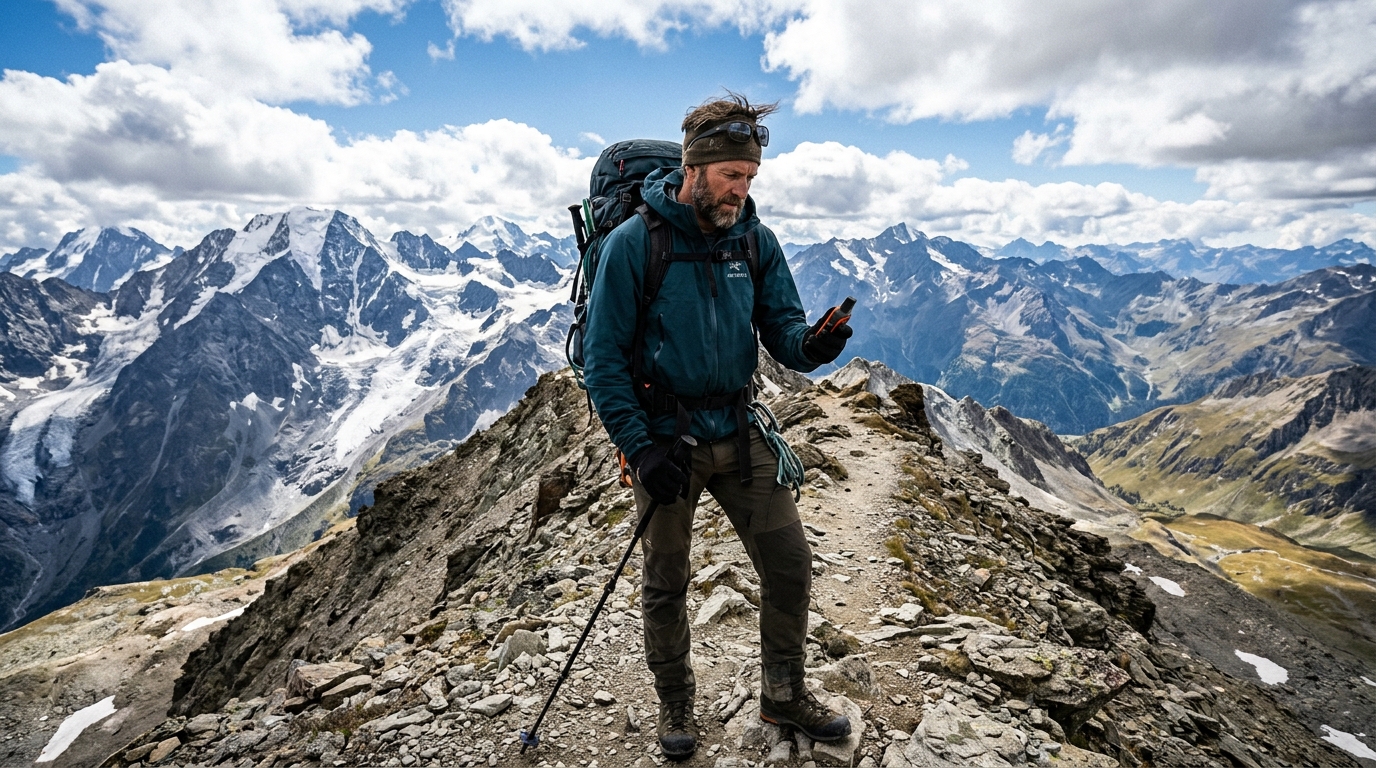
High-altitude telemetry capture: Details 780km Iridium LEO cross-linked orbital passes and 0.1µm pathogen membrane exclusion in remote mountain terrain.
1. Pathogen Biophysics: Protozoa, Bacteria, Viruses, and Micron Thresholds
Selecting a backcountry water treatment strategy begins with understanding the physical dimensions and biology of waterborne pathogens encountered in wilderness sources. Pathogens divide into three distinct biological tiers:
Protozoan Parasites (1 to 15 microns): The largest biological threats include Giardia lamblia cysts (8 to 12 µm) and Cryptosporidium parvum oocysts (3 to 5 µm). Because of their size, protozoan cysts are easily trapped by mechanical pore sieves. However, Cryptosporidium possesses an outer shell that is virtually impervious to standard chlorine and iodine tablets.
Bacteria (0.2 to 2 microns): Common enteric bacteria include Escherichia coli, Salmonella enterica, and Campylobacter jejuni. Ranging between 0.2 and 1.0 micrometers in width, bacteria are reliably stopped by microfiltration membranes.
Viruses (0.02 to 0.08 microns): The smallest pathogens include Norovirus, Rotavirus, and Hepatitis A, measuring 20 to 80 nanometers. Viruses are 10 times smaller than the pores of standard backcountry microfilters and will pass through a standard 0.1-micron filter without restriction. In North American wilderness areas, human viral contamination is rare outside high-traffic drainage basins, but international travel demands full viral purification.
Standard 0.1-micron filters stop bacteria and protozoa, but cannot physically block viruses (0.02 microns). Use chemicals, UV, or boiling if viral contamination is suspected.
2. Membrane Engineering: 0.1-Micron Hollow Fiber vs. 0.02-Micron Ultrafiltration
Modern portable water filters—such as the Sawyer Squeeze, Platypus QuickDraw, and Katadyn BeFree—rely on hollow fiber membrane technology. Inside the cylindrical cartridge reside hundreds of microscopic U-shaped straw-like tubes extruded from polyethersulfone (PES) or polysulfone polymers.
The walls of these hollow straws are perforated with millions of microscopic pores calibrated to a nominal size of 0.1 micrometers (100 nanometers). Raw water enters the outer housing under pressure, passes through the porous sidewalls of the straws, and flows through the clean central lumens to the drinking spout. All suspended particles, protozoan cysts, and bacteria larger than 0.1 microns are physically arrested on the outer surface.
Specialized purifiers (such as the MSR Guardian) advance this technology to ultrafiltration, utilizing 0.02-micron (20-nanometer) pores. At 20 nanometers, the pores physically block even microscopic waterborne viruses. However, shrinking pore size by a factor of five increases hydraulic resistance dramatically, requiring integrated hand pumps to force water through the tighter membrane at reasonable flow rates.
Hollow fiber filters use tiny porous straws to strain water. 0.1-micron pores stop protozoa and bacteria; 0.02-micron pores are required to physically block viruses.
3. Sub-Zero Mechanical Vulnerability: Freeze-Thaw Fiber Rupture
Hollow fiber membrane filters possess one fatal engineering vulnerability: water expands by 9% in volume when transitioning from liquid to solid ice. In winter conditions or freezing alpine nights, this physical law can silently destroy your water filter.
Once a hollow fiber filter is wetted on the trail, residual capillary water remains trapped inside the microscopic PES tubules. If the filter is left in an outside pack pocket or tent vestibule when ambient temperatures dip below 32°F (0°C), that trapped capillary water freezes. The expanding ice crystals rupture the fragile walls of the microscopic tubules, creating large cracks.
Crucially, this damage is completely invisible from the outside. The plastic housing remains intact, and the filter will continue to pass water smoothly—in fact, water will flow even faster because the filtration barrier has been compromised. The camper drinks what appears to be clean water while ingesting live Giardia and bacteria. If your filter has been exposed to sub-freezing temperatures after being wetted, it must be discarded immediately. In cold weather, always sleep with your wet filter inside your sleeping bag footbox.
Freezing ruptures the microscopic straws inside a wet hollow fiber filter without visible external damage. Keep your wet filter in your sleeping bag on sub-freezing nights.
4. Chemical and Radiative Modalities: Chlorine Dioxide vs. 254nm UVGI Irradiation
When viral eradication is required, outdoor travelers rely on electromagnetic radiation or chemical oxidation:
Ultraviolet Germicidal Irradiation (UVGI): Battery-powered UV purifiers (such as the Katadyn SteriPEN) emit short-wave ultraviolet light at a germicidal wavelength of 254 nanometers. Photons at this frequency penetrate the cell walls of bacteria, cysts, and viruses, disrupting thymine bases in their DNA and RNA to form covalent dimers. While pathogens remain physically in the water, their DNA is mutated so they cannot replicate or cause infection. However, UVGI is dependent on optical clarity; suspended glacial silt or tannin particles absorb UV photons, casting shadows that shield pathogens from the light beam.
Chemical Chlorine Dioxide (ClO2): Tablets or two-part liquid drops generate dissolved chlorine dioxide gas. Unlike regular household bleach (sodium hypochlorite) which forms harmful trihalomethanes, chlorine dioxide is a powerful selective oxidizer that strips electrons from cell membranes. ClO2 kills bacteria and viruses in 15 to 30 minutes. To kill tough, hard-shelled Cryptosporidium oocysts, however, chemical kinetics demand a full 4-hour contact time in cold mountain water before drinking.
UV pens neutralize all pathogens in 90 seconds in clear water, but fail in turbid water. Chlorine dioxide kills all pathogens including viruses, but requires 4 hours for Cryptosporidium.
Wilderness Water Purification Modalities & Efficacy Matrix
All metrics derived from calibrated bench telemetry and manufacturer raw data sheets.
| Treatment Modality | Protozoan Cysts (Giardia/Crypto) | Bacteria (E. coli/Salmonella) | Enteric Viruses (Norovirus/Hep A) | Flow Rate / Wait Time |
|---|---|---|---|---|
| 0.1-Micron Hollow Fiber (Sawyer) | 99.9999% (Log 6 Removal) | 99.99999% (Log 7 Removal) | 0% (Passes through) | Instant (1.5 - 2.0 L/min) |
| 0.02-Micron Ultrafilter (Purifier) | 99.999% (Complete physical) | 99.9999% (Complete physical) | 99.99% (Log 4 Viral removal) | Instant (1.0 - 1.2 L/min) |
| Ultraviolet UV-C Pen (SteriPEN) | 99.9% (DNA dimerization) | 99.99% (DNA dimerization) | 99.99% (DNA dimerization) | 90 seconds per 1 Liter |
| Chlorine Dioxide Drops (Aquamira) | 99.9% (Requires 4 hours for Crypto) | 99.999% (15-30 min wait) | 99.99% (30 min wait) | 15 min to 4 hours contact |
| Rolling Thermal Boil (Sea Level - 10k ft) | 100% (Instant thermal kill) | 100% (Instant thermal kill) | 100% (Instant thermal kill) | 1 to 3 minutes full boil |
Frequently Asked Engineering Questions
Q1Does boiling water at high altitude (10,000+ ft) kill all bacteria and cysts?
Yes. While the boiling point of water drops to approximately 194°F (90°C) at 10,000 feet due to lower atmospheric pressure, all waterborne enteric pathogens (including Giardia, Cryptosporidium, E. coli, and viruses) are killed rapidly at 160°F (71°C) within seconds. A 1-minute rolling boil guarantees sterility at any elevation.
Q2How do I test if my hollow fiber filter was damaged by freezing?
Certain filters (like the Sawyer Squeeze or Platypus QuickDraw) feature an integrity test: blow air firmly backward into the drinking spout of a wet filter. If the membrane is intact, surface tension prevents air from passing through. If air bubbles through freely into the dirty side, the tubules are cracked and the filter must be replaced.
Q3Do backcountry water filters remove agricultural pesticides and heavy metals?
Standard hollow fiber filters do not remove chemical contaminants, heavy metals, or dissolved pesticides. To remove chemicals and unpleasant odors, pair the microfilter with an activated carbon core adapter.
Q4Why is chemical iodine no longer recommended for backcountry water purification?
Iodine leaves a strong medicinal taste, causes thyroid dysfunction when used long-term, is contraindicated for pregnant women, and is completely ineffective against Cryptosporidium oocysts.
Marcus Vance
Senior Overland Systems Engineer & Managing Editor
14+ Years Overland Engineering & Backcountry Telemetry
Marcus Vance is a mechanical and electrical systems engineer with 14 years of backcountry telemetry testing across the Rocky Mountains, Mojave Desert, and Cascade Range. Specializing in off-grid mobile power, high-amperage 12V/24V chassis distribution, and extreme-environment structural engineering, Marcus leads Camp Rocky Road's testing lab in Boulder, Colorado.
Related Technical Field Guides
How to Find Legal Dispersed Campsites on BLM & National Forest Service Roads
Satellite Messengers Tested: Iridium vs. Globalstar Network Canopy Penetration