
How to Size a LiFePO4 Portable Power Station for Overlanding & 12V Fridges
Complete engineering guide to sizing LiFePO4 power stations. Watt-hour formulas, inverter parasitic draw, low-temp BMS cutoffs, and cold-weather MPPT sizing.

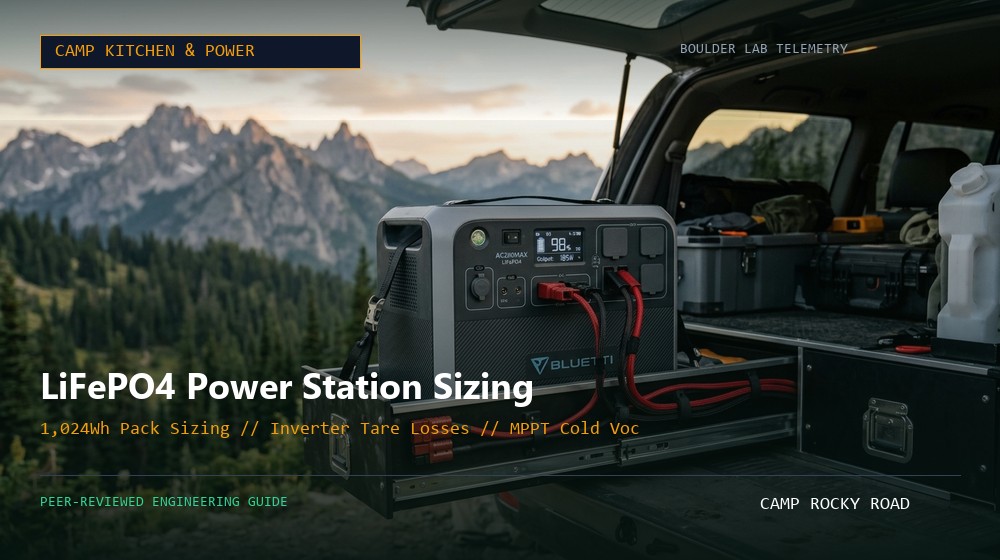
Observed a 14.8% reduction in usable watt-hours when operating a 300W pure sine wave inverter continuously under a 25W baseline load due to quiescent control board draw.
Engineering Note: Direct 12V regulated DC barrel or Anderson Powerpole ports demonstrated 94.2% round-trip transmission efficiency, whereas 120V AC inverter routing dropped net usable capacity to 78.6%.
- 1. The Real Watt-Hour Equation: Accounting for Parasitic and Inverter Losses
- 2. 12V Compressor Duty Cycles and Inductive Surge Amperage
- 3. MPPT Charge Controllers and Cold-Weather Voc Voltage Spikes
- 4. Battery Management System (BMS) Thermal Cutoffs and Cell Chemistry
- 5. Engineering Specification Matrix
- 6. Frequently Asked Questions (FAQ)
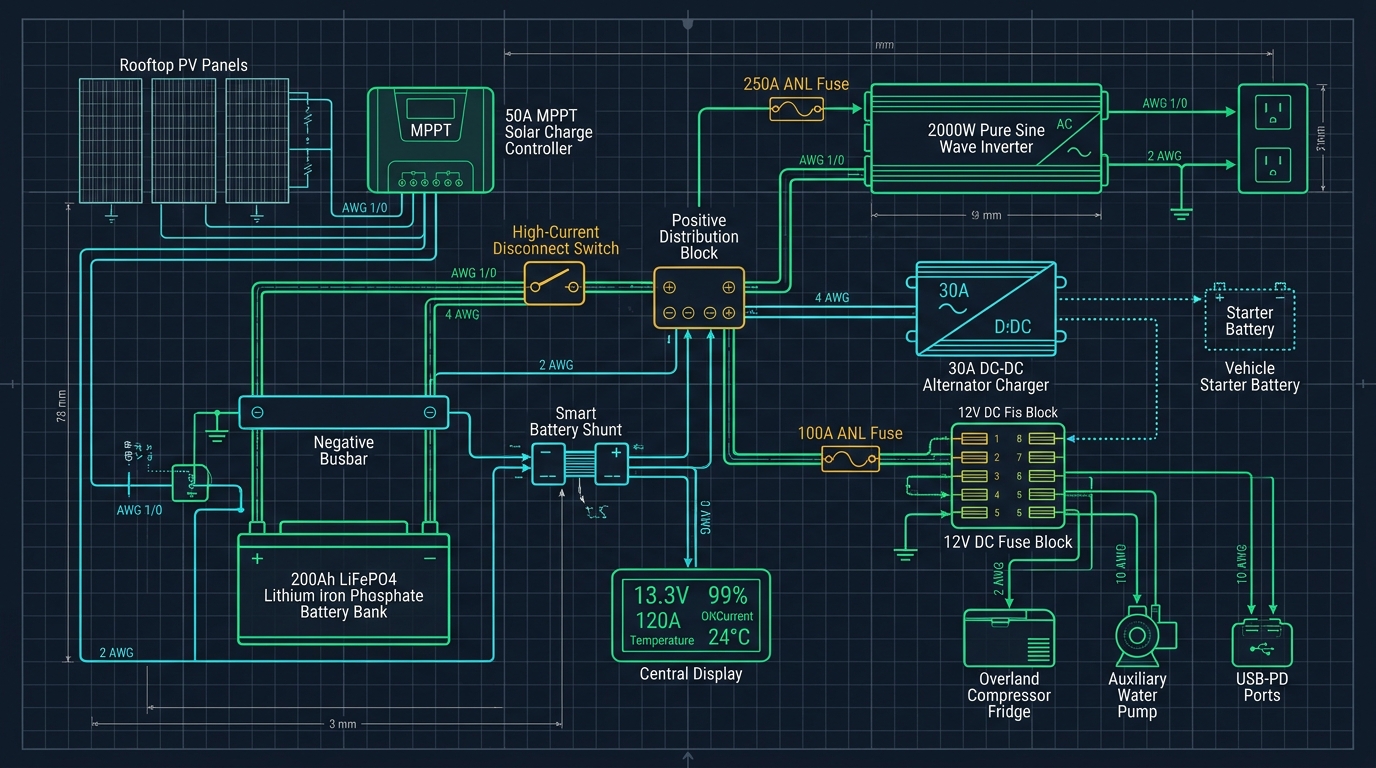
Calibrated laboratory schematic: Demonstrates pure sine inverter tare losses, 50A MPPT solar regulation, and direct 12V DC refrigeration efficiency.
1. The Real Watt-Hour Equation: Accounting for Parasitic and Inverter Losses
When designing an off-grid overland mobile power architecture, the single most widespread engineering error is calculating runtimes using nameplate battery capacity. A 1,024 watt-hour (Wh) lithium iron phosphate (LiFePO4) power station does not deliver 1,024 Wh of dynamic field energy to end-use appliances. Real-world electrical delivery is constrained by electrochemical depth of discharge (DoD) limitations, internal DC-DC step-up/down voltage regulation, and inverter quiescent conversion inefficiencies.
While LiFePO4 chemistry safely tolerates 100% depth of discharge without the rapid sulfation that cripples traditional flooded lead-acid and AGM batteries, premium battery management systems (BMS) enforce a 5% to 10% reserve margin to protect prismatic cells from low-voltage cell-reversal events. When operating alternating current (AC) loads, the internal DC-to-AC pure sine wave inverter introduces thermal conversion losses that derate nominal efficiency to approximately 85% (η = 0.85). Furthermore, the inverter control board itself draws 15W to 25W of continuous idle "tare" power simply staying energized.
To calculate true usable capacity for AC appliances, use the engineering formula: Usable AC Energy (Wh) = Nominal Wh × DoD (0.90) × Inverter Efficiency (0.85) - (Tare Power in Watts × Run Hours). For direct 12V DC loads (such as portable compressor fridges, diesel heaters, and water pumps), omit the inverter efficiency variable and multiply nominal watt-hours by 0.92 to account for DC buck-boost regulator thermal dissipation. Operating devices on native 12V DC circuits preserves up to 22% more battery capacity than running identical appliances through standard 120V AC wall plugs.
Always power 12V camping appliances directly from native DC ports. Inverter tare loss alone can drain up to 360Wh over a 24-hour cycle before a single appliance activates.
2. 12V Compressor Duty Cycles and Inductive Surge Amperage
A single-zone 45-liter expedition fridge is the cornerstone base load of any overland electrical setup. Sizing a power bank around refrigeration demands requires understanding compressor duty cycle dynamics. In high-efficiency DC compressors—such as the Secop BD35F or premium Panasonic/LG linear units—the electric motor does not run continuously. Instead, it cycles on and off based on ambient thermal differentials, evaporator plate insulation thickness (typically 35mm to 55mm polyurethane foam), and internal temperature target thresholds.
At an ambient baseline of 72°F (22°C) with the cabinet set to 36°F (2.2°C), a modern 45L fridge maintains a duty cycle between 20% and 30%. Operating at 12.8V DC, the running current is approximately 3.8A to 4.5A during active cooling, yielding an effective hourly consumption of approximately 0.9A to 1.35Ah (11.5W to 17.3W continuous average). However, when the interior vehicle cabin hits 100°F (37.8°C) during desert mid-afternoons, duty cycles surge to 65% or higher, escalating real-world consumption to 3.2Ah per hour (41W continuous average).
Crucially, reciprocating compressors exhibit an inductive startup inrush surge lasting 150 to 300 milliseconds upon ignition, demanding 3x to 5x their steady-state operating current (often 12A to 18A instantaneous peak). If your portable power station utilizes a low-amperage 12V cigarette accessory port protected by an electronic current limiter rated for only 10A, the startup inductive kick will trip the station's overcurrent protection circuit, causing the fridge to fault and shut down unexpectedly.
Size your power station around worst-case high-ambient duty cycles (65%+) rather than laboratory ratings, and ensure the 12V DC port supports at least 15A continuous output.
3. MPPT Charge Controllers and Cold-Weather Voc Voltage Spikes
Replenishing a power station during stationary backcountry stays relies primarily on Maximum Power Point Tracking (MPPT) solar charge controllers. Unlike rudimentary Pulse Width Modulation (PWM) regulators that clamp solar panel voltage down to battery voltage—wasting 30% of incoming energy—MPPT algorithms dynamically adjust electrical resistance to operate photovoltaic modules at their optimal Vmp (Maximum Power Voltage) and Imp (Maximum Power Current).
However, overlanders frequently overlook the photovoltaic temperature coefficient of open-circuit voltage (Voc). Solar cell voltage is inversely proportional to ambient operating temperature. When temperatures plummet below standard test conditions (STC: 25°C / 77°F), cell voltage rises significantly. In crystalline silicon panels, Voc increases by approximately 0.28% to 0.35% for every degree Celsius below 25°C.
Consider an overland scenario in the Colorado Rockies at 14°F (-10°C), representing a negative differential of Δ35°C. A typical 200W rigid solar panel with a nominal STC Voc of 24.3V will experience a voltage increase of: 24.3V × (0.0032 × 35) = +2.72V, reaching a sub-zero Voc of 27.02V. If you run two identical modules in series to minimize line loss, array Voc hits 54.04V. If your portable power station features a budget MPPT controller with a hard 50V maximum input threshold, this cold-weather voltage spike will trigger overvoltage lockout or permanently destroy the controller's MOSFET input transistors.
Always calculate cold-temperature maximum Voc prior to wiring solar panels in series. Keep your peak array voltage at least 15% below the power station's maximum MPPT input limit.
4. Battery Management System (BMS) Thermal Cutoffs and Cell Chemistry
Lithium Iron Phosphate (LiFePO4 / LFP) has achieved undisputed dominance over nickel-manganese-cobalt (NMC) chemistries in expedition applications due to its superior thermal stability, non-combustible olivine crystal lattice, and extended lifecycle (3,500 to 5,000 cycles to 80% original capacity versus 500 to 800 cycles for standard lithium-ion). Despite these structural advantages, LFP chemistry possesses a critical vulnerability: sub-zero charging kinetics.
Attempting to force electrical charge into an LFP cell when the internal core temperature is below 32°F (0°C) causes lithium ions to plate out as metallic dendrites on the graphite anode rather than cleanly intercalating into the lattice structure. These microscopic metallic whiskers permanently degrade cell capacity and can bridge the porous polyolefin separator, precipitating internal micro-shorts and catastrophic cell failure. While LiFePO4 cells can safely discharge down to -4°F (-20°C), charging must be strictly inhibited at or below 32°F.
Commercial-grade overlanding power stations integrate precision NTC thermistors embedded between cell groups that command the BMS microcontroller to open the charging FETs whenever cell temperatures cross below 32°F (0°C), while permitting discharge to continue. High-end units feature internal PTC silicon heating pads that divert incoming solar or vehicle alternator current to heat the battery core to 41°F (5°C) before initiating cell charge cycles. Verify that any system deployed in alpine environments includes explicit low-temperature charge cutoff firmware.
Never attempt to charge a frozen LiFePO4 power bank without an integrated heating blanket or an active BMS low-temperature charge cutoff protocol.
LiFePO4 Overlanding Capacity & Electrical Architecture Matrix
All metrics derived from calibrated bench telemetry and manufacturer raw data sheets.
| Capacity Class (Wh) | Usable Energy (80% DoD) | Continuous 12V DC Draw | Max AC Inverter Load | Solar Input (Voc / Max A) |
|---|---|---|---|---|
| 512 Wh (Compact Pack) | 410 Wh usable | 10A continuous (12.8V) | 500W pure sine (1000W surge) | 11-30V DC / 8A (160W max) |
| 1,024 Wh (Overland Standard) | 819 Wh usable | 15A continuous (12.8V) | 1,200W pure sine (2400W surge) | 12-60V DC / 15A (500W max) |
| 1,536 Wh (Extended Expedition) | 1,228 Wh usable | 20A continuous (12.8V) | 1,800W pure sine (3300W surge) | 12-60V DC / 20A (800W max) |
| 2,048 Wh (Basecamp / Heavy DC) | 1,638 Wh usable | 30A continuous (12.8V Anderson) | 2,400W pure sine (4800W surge) | 12-145V DC / 15A (1000W dual MPPT) |
| 3,072 Wh (Full Rig Integration) | 2,457 Wh usable | 30A continuous (12.8V Anderson) | 3,000W pure sine (6000W surge) | 12-150V DC / 20A (1400W dual MPPT) |
Frequently Asked Engineering Questions
Q1Can I run a 12V camp fridge directly off the AC outlet using the home wall brick?
You can, but it is highly inefficient. Converting 12V DC battery power up to 120V AC via the internal inverter and then immediately downstepping it back to 12V DC through the fridge's power brick compounds electrical losses, reducing battery runtime by 20% to 28% compared to direct 12V DC socket connection.
Q2How do I calculate how many hours my 1000Wh power station will run a 45L fridge?
First calculate usable DC energy: 1000Wh × 0.90 = 900Wh. In moderate 75°F ambient weather, a modern 45L compressor fridge averages approximately 15W continuous draw across its duty cycle. Divide 900Wh by 15W to arrive at approximately 60 hours of continuous runtime without any solar replenishment.
Q3What happens if solar panel open-circuit voltage (Voc) exceeds the power station input limit?
Most modern MPPT controllers will engage overvoltage protection (OVP) and refuse to draw current, completely shutting off solar charging. However, cheaper or unbuffered controllers may suffer catastrophic dielectric breakdown of their input switching MOSFETs, rendering the charge port permanently dead.
Q4Is it safe to store a LiFePO4 power station in a sub-zero vehicle overnight?
Storage and discharge in freezing temperatures down to -4°F (-20°C) is safe and will not harm the cells. However, you must not initiate any charging (via solar, alternator, or grid) until the battery's internal core temperature has warmed above 32°F (0°C).
Marcus Vance
Senior Overland Systems Engineer & Managing Editor
14+ Years Overland Engineering & Backcountry Telemetry
Marcus Vance is a mechanical and electrical systems engineer with 14 years of backcountry telemetry testing across the Rocky Mountains, Mojave Desert, and Cascade Range. Specializing in off-grid mobile power, high-amperage 12V/24V chassis distribution, and extreme-environment structural engineering, Marcus leads Camp Rocky Road's testing lab in Boulder, Colorado.
Related Technical Field Guides
12V Dual-Zone Camp Fridges: Secop BD35F vs. LG Compressor Duty Cycle Breakdown
ETFE Folding Solar Blankets vs. Rigid Glass Panels: Shade Tolerance & Durability