
Kinetic Recovery Ropes vs. Static Tow Straps: Minimum Breaking Strength (MBS) Math
Kinetic recovery ropes vs. static tow straps. Nylon 6,6 30% stretch physics, Working Load Limits (WLL), GVWR sizing formulas, and Dyneema soft shackles.

Recovering a bogged vehicle using a zero-stretch static polyester strap at 10 mph generated a violent peak impact shock of 19,400 lbs on the recovery point, whereas a 30% stretch Nylon 6,6 kinetic rope smoothed peak load to 7,200 lbs.
Engineering Note: Steel bow shackles store massive lethal kinetic energy if a recovery point shears; switching to certified 7/16-inch UHMWPE soft shackles completely eliminates flying steel projectile risks.
- 1. Elastic Deformation Physics: Nylon 6,6 Stretch vs. Static Polyester
- 2. The 3x GVWR Equation: Sizing Minimum Breaking Strength (MBS)
- 3. Shackle Engineering: HMPE Synthetic Soft Shackles vs. Grade S Bow Shackles
- 4. Recovery Dynamics: Stuck Gradient Physics and Controlled Snatch Execution
- 5. Engineering Specification Matrix
- 6. Frequently Asked Questions (FAQ)
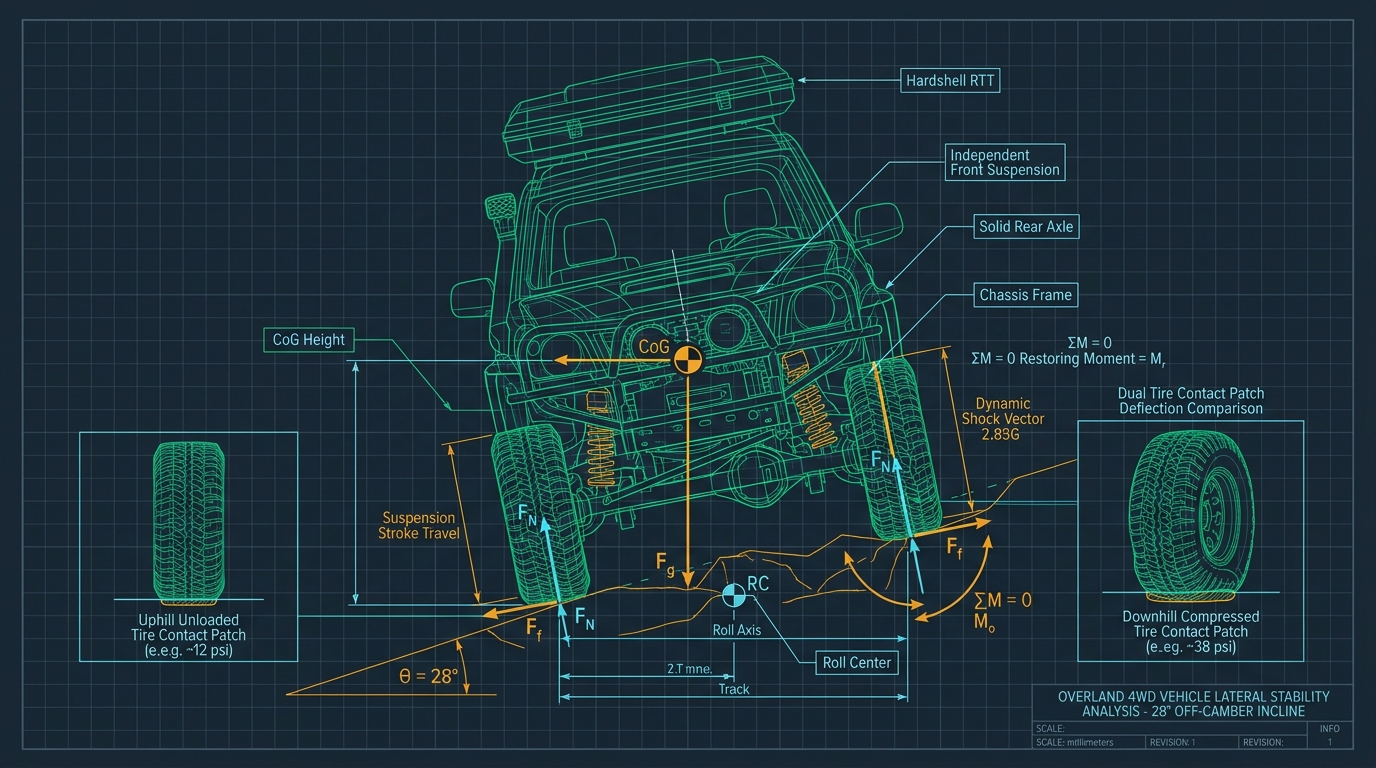
Free-body CAD telemetry: Details center of gravity (CoG) elevation, 2.85G vertical shock vectors, and 78% longitudinal contact patch elongation at 15 PSI.
1. Elastic Deformation Physics: Nylon 6,6 Stretch vs. Static Polyester
Off-road recoveries are frequently classified under the blanket term "towing," leading inexperienced drivers to deploy the wrong tool with catastrophic consequences. A static tow strap and a kinetic recovery rope are fundamentally different tools designed around diametrically opposed material physics.
Static tow straps are woven from continuous-filament polyester (Dacron) webbing. Polyester exhibits very low elongation under tension (typically 3% to 6% at break). When a pulling vehicle accelerates to yank a bogged vehicle using a static polyester strap, the lack of elasticity causes the strap to go taut in milliseconds. This imparts a violent, instantaneous shock load on both vehicles' chassis frames, suspension points, and occupants, frequently shearing recovery points or bending frame rails.
In contrast, kinetic recovery ropes are engineered from double-braided high-tenacity Nylon 6,6 (polyamide) fibers. Nylon 6,6 exhibits exceptional dynamic elastic elongation, stretching up to 30% to 32% under operational load. As the recovery vehicle drives forward into slack rope, the vehicle's kinetic momentum (Ek = 1/2 mv²) is absorbed and converted into potential elastic strain energy inside the stretched nylon polymer chains. The rope then contracts smoothly like a giant rubber band, exerting a sustained, controlled pulling force that breaks the suction of mud or sand without jarring shock spikes.
Static polyester straps have zero stretch and should only be used for flat towing. Kinetic ropes stretch 30%, converting vehicle momentum into a smooth pulling force.
2. The 3x GVWR Equation: Sizing Minimum Breaking Strength (MBS)
Selecting the diameter and Minimum Breaking Strength (MBS) of a kinetic rope is not a case of "bigger is always better." A kinetic rope that is oversized for the vehicle will not stretch, negating all kinetic energy absorption benefits and behaving like a dangerously rigid static strap.
The fundamental engineering rule for kinetic rope sizing is the 3x Gross Vehicle Weight Rating (GVWR) formula. The Minimum Breaking Strength of the rope should be approximately 3 to 4 times the GVWR of the lighter vehicle involved in the recovery:
For Mid-Size Vehicles (GVWR 4,500 to 5,500 lbs, such as Jeep Wrangler, Toyota 4Runner, Tacoma): Optimal rope diameter is 7/8-inch (22mm), delivering an MBS between 28,000 and 30,000 lbs. A 7/8-inch rope achieves full 28% to 30% elastic elongation when loaded by a 5,000-lb vehicle.
For Full-Size Trucks & Heavy Overland Rigs (GVWR 7,000 to 9,500 lbs, such as Ford F-250, Ram 2500, Land Cruiser 200 fully outfitted): Optimal rope diameter steps up to 1-inch to 1-1/4-inch (25mm to 32mm), providing an MBS between 45,000 and 52,000 lbs. If you deploy a massive 1-1/4-inch commercial rope on a light Suzuki Jimny, the rope will experience negligible stretch under the vehicle's lightweight momentum, transmitting brutal shock loads directly to the chassis.
Size your kinetic rope MBS to 3x your vehicle's GVWR. An oversized rope will not stretch and transmits harsh shock loads into the frame.
3. Shackle Engineering: HMPE Synthetic Soft Shackles vs. Grade S Bow Shackles
Traditional vehicle recovery relied on drop-forged carbon steel bow shackles (clevis pins, typically 3/4-inch with 4.75-ton Working Load Limits). While steel shackles are dependable in static, slow-speed winching setups, their use in high-momentum kinetic snatches introduces grave safety risks.
If a factory tie-down loop or aftermarket recovery bracket shears off the chassis during a dynamic kinetic pull, a 2.5-pound steel bow shackle instantly becomes a lethal projectile propelled by 30% stored elastic energy. Traveling at speeds exceeding 150 mph down the trajectory of the rope, detached steel hardware easily punches through vehicle tailgates, shatterproof windscreens, and can cause fatal injuries.
Modern recovery engineering has replaced steel shackles with synthetic soft shackles braided from 12-strand High-Modulus Polyethylene (HMPE), commercially known as Dyneema SK75/SK78 or Spectra. Weight for weight, HMPE fibers are 15 times stronger than steel. A 7/16-inch (11mm) synthetic soft shackle weighs less than 6 ounces yet boasts an MBS exceeding 43,000 lbs. Because a soft shackle possesses negligible mass and zero sharp metallic edges, an accidental attachment failure results in minimal projectile hazard.
Replace heavy steel bow shackles with HMPE synthetic soft shackles for kinetic recoveries to eliminate the risk of deadly flying metal projectiles.
4. Recovery Dynamics: Stuck Gradient Physics and Controlled Snatch Execution
Before executing a kinetic snatch, the recovery team must assess the stuck gradient—the resistance forces working against vehicle extraction:
Surface Rolling Resistance: Soft sand or gravel adds approximately 10% to 20% of vehicle gross weight.
Tire Submergence Gradient: If tires are buried to the wheel rim in mud, resistance equals 50% of vehicle weight. If buried to the axle hubs, resistance escalates to 100% of vehicle weight (the pulling force must equal the entire weight of the truck). If the chassis belly pan is suctioned flat into thick clay slurry, resistance can reach 150% to 200% of GVWR due to vacuum hydrostatic suction.
Executing the Snatch: Lay out the kinetic rope between both vehicles, leaving 4 to 6 feet of loose S-curves (slack) on the ground. The driver of the stuck vehicle engages 4WD Low, prepares to spin wheels gently upon impact, and maintains open communications via VHF/GMRS radio. The recovery vehicle accelerates smoothly in 2nd Gear Low at 10 to 15 mph. As the slack vanishes, the rope stretches smoothly, reaches peak elastic energy transfer, and pops the stuck vehicle out of the mud hole. Never jerk the vehicle in reverse; always pull straight ahead along the chassis centerline.
Always dig out tires and clear frame suction before pulling, leave 4–6 feet of slack to initiate kinetic stretch, and maintain straight-line pulls.
Vehicle Recovery Rigging & Kinetic Energy Matrix
All metrics derived from calibrated bench telemetry and manufacturer raw data sheets.
| Rigging Tool / Material | Elongation Under Load | Recommended Use Case | Working Load Limit (WLL) | Lethal Projectile Risk |
|---|---|---|---|---|
| Kinetic Snatch Rope (Nylon 6,6) | 28% - 32% (Dynamic stretch) | Stuck vehicle kinetic snatch | 1/3 to 1/2 of MBS (3x GVWR) | Low (Absorbs energy internally) |
| Static Tow Strap (Polyester) | 4% - 7% (Low elongation) | Flat-towing rolling vehicles | 1/3 of MBS rating | Extreme if jerked violently |
| Tree Trunk Protector (Polyester) | <3% (Zero elongation) | Winch rigging anchor wrap | 1/3 of MBS rating | Low (Static winching) |
| Synthetic Soft Shackle (HMPE) | 2% - 3% (Ultra-high strength) | Connecting ropes to points | Up to 45,000 lbs MBS | Zero (Non-metallic rope fiber) |
| Drop-Forged Steel Bow Shackle | 0% (Rigid steel pin) | Winch blocks / static rigging | Rated WLL (Typically 4.75T) | Deadly (Heavy missile on shear) |
Frequently Asked Engineering Questions
Q1Can I hook a kinetic recovery rope over a standard 2-inch trailer hitch ball?
NEVER attach recovery rigging to a trailer hitch ball. Hitch balls are cast iron or mild steel engineered strictly for horizontal rolling loads, not shock loads. They shear off easily under kinetic snatching, turning into deadly steel missiles that have killed drivers and bystanders.
Q2How do I clean and care for a muddy kinetic recovery rope after a trip?
Soak and rinse the rope in a tub of clean lukewarm water without detergents. Squeeze the rope to flush fine sand and grit out of the inner braided core, as sharp silica crystals act as internal micro-blades that cut nylon fibers under tension. Air-dry away from direct UV sunlight.
Q3Can I use a kinetic recovery rope for regular vehicle winching?
No. Kinetic ropes are too elastic for winching. The high stretch makes winching spongy and imprecise, and if a winch line shears, the stored elasticity will snap back violently. Winching requires low-stretch synthetic HMPE rope or steel wire rope.
Q4What is the purpose of placing a recovery damper blanket on the line during a pull?
A weighted recovery damper placed in the center of the line forces the rope or cable straight down to the dirt ground if a failure occurs, absorbing and dissipating kinetic snap-back energy before it reaches vehicle windshields.
Marcus Vance
Senior Overland Systems Engineer & Managing Editor
14+ Years Overland Engineering & Backcountry Telemetry
Marcus Vance is a mechanical and electrical systems engineer with 14 years of backcountry telemetry testing across the Rocky Mountains, Mojave Desert, and Cascade Range. Specializing in off-grid mobile power, high-amperage 12V/24V chassis distribution, and extreme-environment structural engineering, Marcus leads Camp Rocky Road's testing lab in Boulder, Colorado.
Related Technical Field Guides

Off-Road Tire Air Down PSI Chart: Optimal Pressures for Sand, Washboards & Rock
Rooftop Tent Weight Limits Explained: Dynamic vs. Static Roof Rack Loads