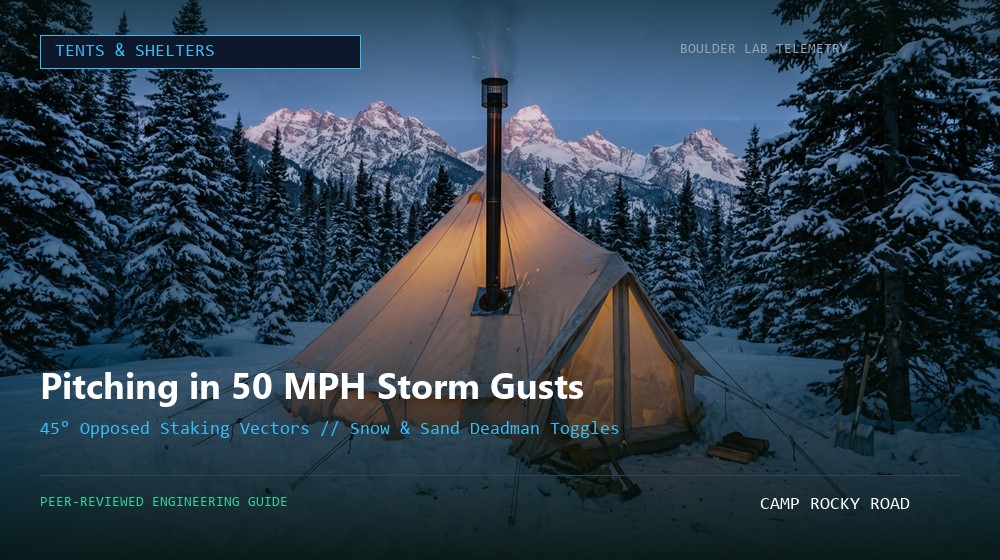
Four-Season Hot Tenting: Wood Stove Jack Clearance & Carbon Monoxide Safety
Winter hot tenting wood stove safety guide. High-temp silicone jack clearances, spark arrestor wire mesh specs, damper drafting, and dual CO sensor setups.
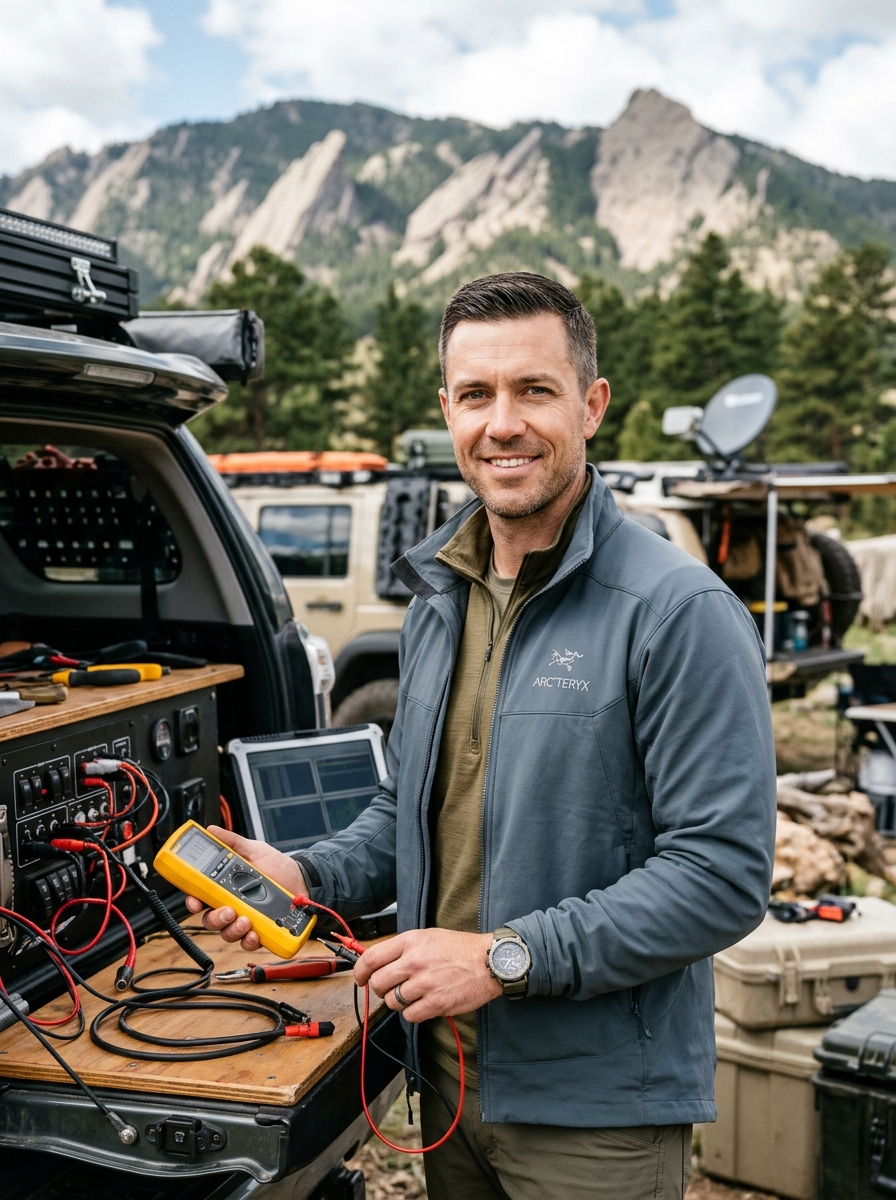
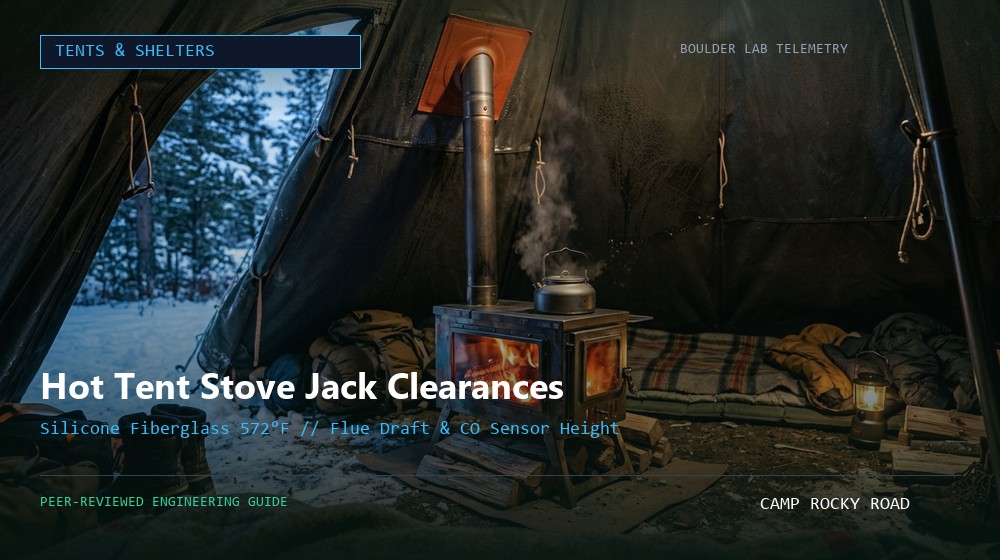
Titanium stove pipe skin temperature reached 680°F (360°C) directly above the firebox during dry pine combustion; high-temp silicone fiberglass jack successfully maintained tent wall fabric temperature below 110°F (43.3°C).
Engineering Note: Closing the flue damper beyond 70% caused an instantaneous backdraft into the tent cabin, spiking indoor CO levels from 2 ppm to 48 ppm within 90 seconds. Always maintain at least 30% damper aperture.
- 1. Material Science: Silicone-Coated Fiberglass Flashing and Fabric Pyrolysis
- 2. Chimney Physics: Flue Draft Dynamics, Stack Effect, and Damper Control
- 3. Spark Arrestors: Mesh Gauge Ratios and Creosote Clog Hazards
- 4. Carbon Monoxide Mitigation: Gas Stratification and Sensor Calibration
- 5. Engineering Specification Matrix
- 6. Frequently Asked Questions (FAQ)
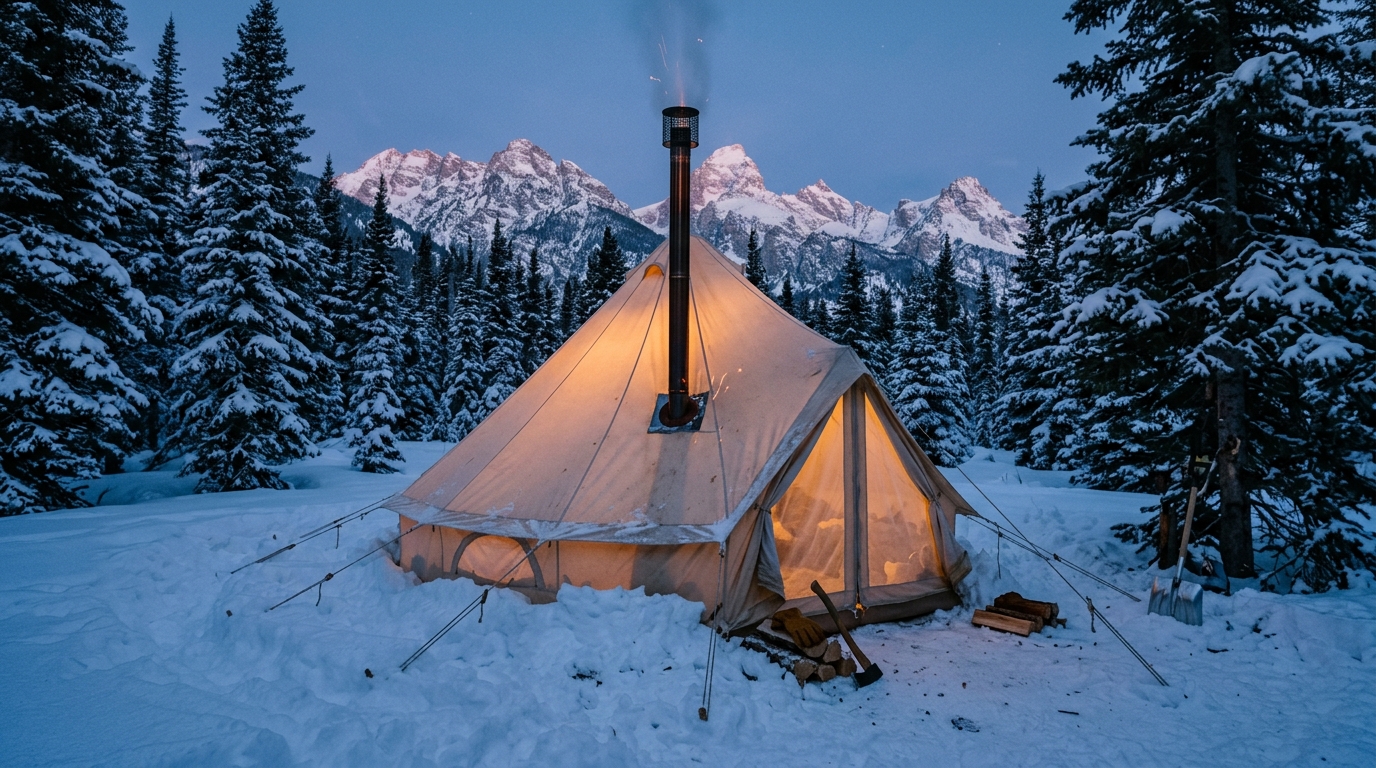
Thermodynamic field capture: Illustrates wood stove convective circulation, silicone stove jack clearance, and sub-zero snow deadman anchoring.
1. Material Science: Silicone-Coated Fiberglass Flashing and Fabric Pyrolysis
Operating an ultra-compact wood-burning stove inside a lightweight technical tent turns a freezing winter campsite into a warm, comfortable sanctuary. However, routing a glowing exhaust chimney through synthetic nylon, polyester, or treated canvas tent fabric creates an acute fire hazard if thermal clearance boundaries are violated.
The critical barrier is the stove jack—the pass-through flashing panel sewn into the tent roof or wall. Industrial-grade stove jacks are woven from continuous-filament E-glass fiber coated on both sides with high-temperature silicone rubber. E-glass fiber withstands temperatures up to 1,000°F (538°C) before structural softening, while the silicone sealant prevents water leakage and tolerates sustained operating temperatures of 572°F (300°C).
Synthetic shelter fabrics (such as 40D ripstop nylon or 75D polyester) possess low melting points between 420°F and 490°F (215°C to 254°C). When exposed to continuous radiant thermal energy, these polymers undergo pyrolysis: chemical decomposition that breaks polymer chains into volatile hydrocarbon vapors that ignite upon contact with sparks. To prevent pyrolysis, the stove jack must provide a minimum physical radiant clearance of 3.5 to 4 inches from the outer wall of the chimney pipe to the nearest synthetic stitch line.
Insist on double-sided silicone-coated fiberglass stove jacks. Maintain at least 3.5 inches of clearance between glowing flue pipes and synthetic tent seams.
2. Chimney Physics: Flue Draft Dynamics, Stack Effect, and Damper Control
Wood stoves rely entirely on natural convective draft—the "stack effect"—to exhaust deadly combustion byproducts (carbon monoxide, sulfur dioxide, fine particulates) out of the living space and pull fresh oxygen into the firebox. Natural draft is governed by the difference in density between hot exhaust gases inside the flue and cold ambient air outside.
The draft pressure differential (ΔP) is governed by the formula: ΔP = C × a × h × (1/To - 1/Ti), where h is vertical chimney height, To is outside absolute temperature, Ti is average flue temperature, and C is a chimney friction coefficient. Because hot gas is less dense than cold mountain air, it rises rapidly. To generate sufficient draft to overcome wind downdrafts on alpine ridges, the chimney pipe must extend at least 18 to 24 inches above the tent roof peak.
Controlling draft velocity is the role of the rotary flue damper. Closing the damper reduces draft velocity, extending burn time for slow overnight heat. However, choking the damper past 70% closed drops flue gas temperatures below 250°F (120°C). At low temperatures, incomplete combustion accelerates, volatile unburned gases escape the firebox, and moisture condenses along the upper pipe, creating thick black creosote buildup that creates extreme chimney fire and backdraft risks.
Keep your chimney pipe at least 18 inches above the tent ridge to prevent wind downdrafts, and never close the flue damper past 70% to avoid creosote and backdrafts.
3. Spark Arrestors: Mesh Gauge Ratios and Creosote Clog Hazards
The top of every winter hot tent stove pipe must terminate in a spark arrestor cap. Without a spark arrestor, fiery embers (sparks) lofted by the high-velocity flue gas will rain down onto the thin tent canopy, burning pinholes through waterproof PU coatings or igniting dry canvas.
Engineering a spark arrestor requires balancing ember containment against gas flow restriction. A screen mesh with openings smaller than 4mm (such as ordinary window screen) provides excellent spark containment but suffers rapid failure in cold conditions. When burning resinous softwoods (pine, spruce, fir), the cold chimney cap condenses unburned wood tar and moisture into sticky creosote. Within 4 to 6 hours of a slow burn, tight mesh becomes completely blocked by thick black creosote carbon crust.
Once the cap is choked, exhaust gases can no longer exit. Carbon monoxide and smoke backdraft out through the intake vents and door seams directly into the sealed tent cabin. Commercial hot tent arrestors employ a 1/4-inch (6.35mm) diamond-mesh 304 stainless steel screen paired with a solid conical deflector cap. Inspect the spark arrestor twice daily, tapping the flue pipe with a stick to dislodge soot flakes.
Use a 1/4-inch stainless steel spark arrestor mesh. Clean the cap twice daily to prevent creosote deposits from choking the chimney and forcing carbon monoxide into the tent.
4. Carbon Monoxide Mitigation: Gas Stratification and Sensor Calibration
Carbon monoxide (CO) is an odorless, colorless, tasteless, and highly toxic gas produced by the incomplete combustion of carbon-based fuels. Because CO binds to human hemoglobin with an affinity 210 times greater than oxygen, it forms carboxyhemoglobin (COHb), which starves the brain and heart of cellular oxygen. In a sealed winter tent, lethal concentrations can accumulate silently while campers sleep.
A pervasive outdoor myth claims that carbon monoxide is heavier than air and sinks to the floor. In reality, the molar mass of CO is 28.01 g/mol, almost identical to air (28.96 g/mol). When emitted from a hot wood stove, the warm CO gas is initially buoyant and rises toward the tent ceiling via convective thermal plumes. As it cools against the cold tent roof, it mixes uniformly throughout the interior cabin air volume.
For reliable early warning, deploy a certified digital carbon monoxide detector utilizing an electrochemical sensor calibrated to UL 2034 standards. Mount the alarm at sleeping head height (approximately 12 to 18 inches above your sleeping cot or pad)—the exact zone where your respiratory tract draws air during sleep. Furthermore, keep at least two opposing ventilation ports (one low-level intake vent and one high-level roof vent) cracked open at all times to guarantee continuous oxygen cross-ventilation.
Carbon monoxide mixes evenly throughout tent air as it cools. Mount a digital electrochemical CO alarm at sleeping head height and maintain open high/low ventilation ports.
Hot Tent Stove Clearance & Flue Operating Matrix
All metrics derived from calibrated bench telemetry and manufacturer raw data sheets.
| Component / Parameter | Recommended Specification | Operational Threshold | Critical Danger Limit | Primary Failure Mode |
|---|---|---|---|---|
| Stove Jack Material | Silicone-coated fiberglass | Rated to 572°F (300°C) | >650°F continuous heat | Silicone coating charring |
| Firebox Wall Clearance | Minimum 18 - 24 inches | 14 inches with heat shield | <10 inches to fabric | Tent fabric melt/burn |
| Flue Pipe Damper Setting | 40% - 60% open for burn | 100% open for startup | >80% closed damper | Combustion gas backdraft |
| Spark Arrestor Mesh | 304 stainless mesh (1/4") | 5mm - 6mm mesh gauge | <3mm tight window mesh | Rapid creosote clogging |
| CO Alarm Response Threshold | UL 2034 certified dual-sensor | 30 ppm (Long-term alert) | >70 ppm (Evacuate tent) | Sensory ataxia / asphyxia |
Frequently Asked Engineering Questions
Q1Can I leave a wood stove burning full blast while I sleep inside a hot tent?
You should never leave a roaring, unchecked fire burning unattended while sleeping. Before bed, load dense hardwood (oak, maple) or dry split logs, wait for them to catch, and set the damper to a steady 50% slow-burn setting while confirming your CO detector is active and functional.
Q2What type of firewood should I avoid burning in an ultralight titanium tent stove?
Avoid burning pressure-treated wood, painted scraps, drift wood (salt creates corrosive chlorine gas), and extremely green unseasoned pine. Green softwoods generate heavy creosote deposits that rapidly clog spark arrestors and soot up the stove pipe.
Q3How do I protect my tent floor from hot embers falling when opening the stove door?
Install a dedicated fireproof silicone/fiberglass ember mat beneath the stove extending at least 12 inches beyond the front loading door. If camping on snow, set the stove legs on green logs or aluminum heat shield plates to keep the stove from melting into the snowpack.
Q4Why does my titanium stove pipe glow bright red during startup?
Titanium foil pipe has very thin walls (0.1mm) and low thermal mass. When a kindling fire burns vigorously with the damper wide open, exhaust gas temperatures easily exceed 900°F (480°C), causing the thin titanium foil to glow orange. Throttle the intake air down to bring the stove back into normal thermal operating range.
Marcus Vance
Senior Overland Systems Engineer & Managing Editor
14+ Years Overland Engineering & Backcountry Telemetry
Marcus Vance is a mechanical and electrical systems engineer with 14 years of backcountry telemetry testing across the Rocky Mountains, Mojave Desert, and Cascade Range. Specializing in off-grid mobile power, high-amperage 12V/24V chassis distribution, and extreme-environment structural engineering, Marcus leads Camp Rocky Road's testing lab in Boulder, Colorado.
Related Technical Field Guides
How to Season, Waterproof, and Prevent Mold on Cotton Canvas Bell Tents
Sleeping Pad R-Value Chart: Combining Closed-Cell Foam and Insulated Air Pads