Sleeping Pad R-Value Chart: Combining Closed-Cell Foam and Insulated Air Pads
Sleeping pad R-value chart and winter insulation math. ASTM F3340-18 thermal ratings, conductive ground heat loss, and stacking foam with inflatable air pads.
An uninsulated summer air pad (R-1.3) allowed 48.2 W/m² of thermal body heat to conduct directly into frozen ground, chilling occupant skin within 22 minutes regardless of a 0°F-rated sleeping bag.
Engineering Note: Stacking an R-2.0 closed-cell foam pad beneath an R-4.2 insulated air pad yielded an effective system R-value of 6.2, dropping heat flux to under 9.8 W/m² and maintaining warm comfort all night.
- 1. Standardization: The ASTM F3340-18 Guarded Hot Plate Testing Standard
- 2. Ground Thermodynamics: Fourier's Law of Conductive Heat Loss
- 3. Additive Insulation: Stacking Closed-Cell Foam (CCF) with Air Mats
- 4. Internal Architecture: Radiative Mylar Films vs. Microfiber Lofts
- 5. Engineering Specification Matrix
- 6. Frequently Asked Questions (FAQ)
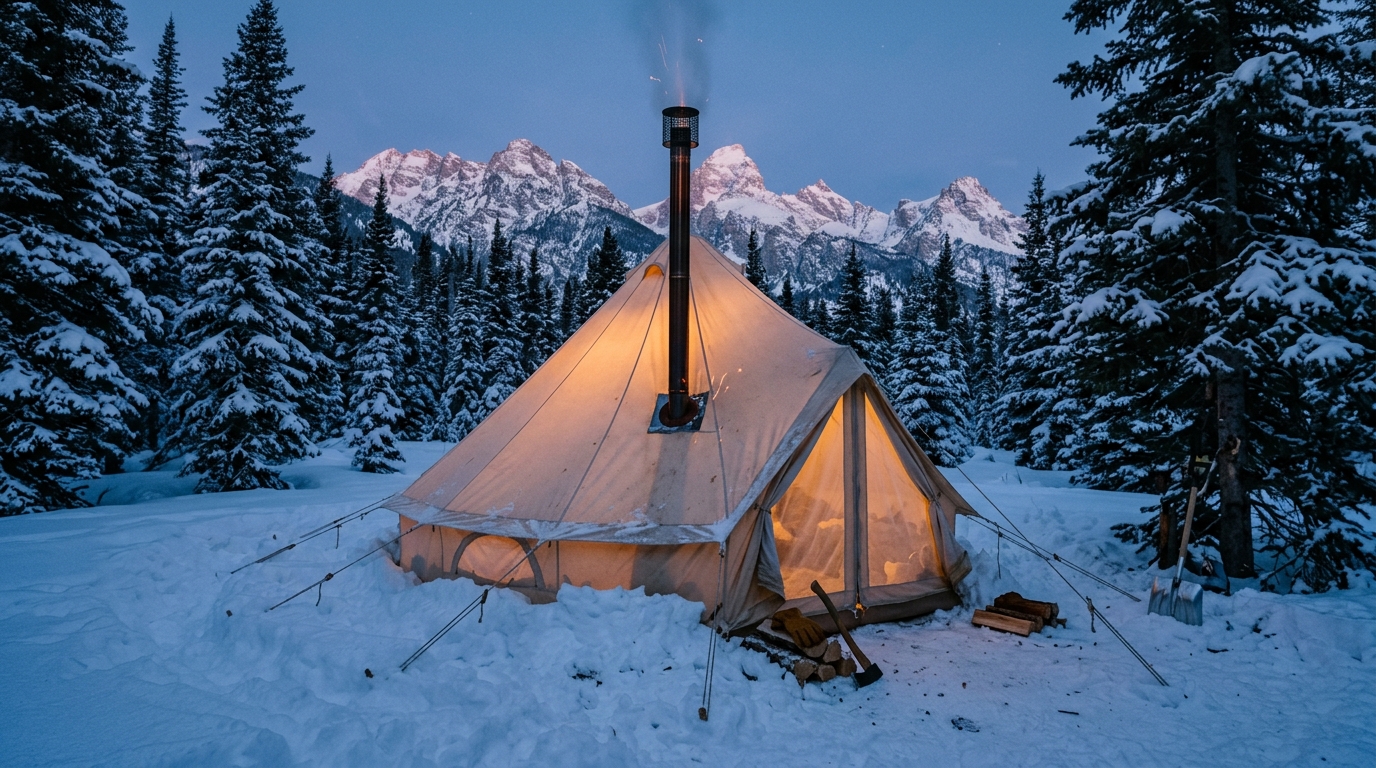
Thermodynamic field capture: Illustrates wood stove convective circulation, silicone stove jack clearance, and sub-zero snow deadman anchoring.
1. Standardization: The ASTM F3340-18 Guarded Hot Plate Testing Standard
Prior to 2020, outdoor gear manufacturers published unstandardized, marketing-driven sleeping pad temperature ratings that left winter backpackers vulnerable to hypothermia. One brand's "three-season" pad was another brand's summer beach mat. The adoption of the ASTM F3340-18 standard eliminated this guesswork by creating an empirical, laboratory-calibrated protocol for measuring thermal resistance (R-value).
Under ASTM F3340-18 testing, the sleeping pad is placed inside a controlled thermal chamber between an upper guarded hot plate maintained at constant human body skin temperature (95°F / 35°C) and a lower cold plate chilled to 41°F (5°C). A continuous mechanical compressive pressure of 2.0 kilopascals (approx. 0.29 PSI)—equivalent to the average distributed body mass of a sleeping human—is applied to compress the pad.
Precise heat-flux transducers measure the rate of electrical energy (in watts) required to keep the upper hot plate at 95°F. The resulting thermal resistance is expressed as an imperial R-value: R = ΔT / Heat Flux (ft²·°F·h/BTU). The higher the R-value, the slower heat conducts from your body into the frozen ground below.
Always verify sleeping pad R-values against the ASTM F3340-18 standard. R-values provide an objective, lab-tested measurement of thermal resistance.
2. Ground Thermodynamics: Fourier's Law of Conductive Heat Loss
A common misconception among cold-weather campers is that a thicker, high-loft down sleeping bag can compensate for a thin, uninsulated sleeping pad. In reality, a sleeping bag provides virtually zero insulation beneath your body.
Down plumes and synthetic continuous-filament batts insulate by trapping pockets of dead air within their 3D loft. When you lie down on your back or side, your body weight (150 to 220 lbs) compresses the sleeping bag fill beneath your shoulders, torso, and hips into a paper-thin layer less than 2mm thick. With its insulating loft completely crushed, the sleeping bag loses its thermal resistance.
Fourier's Law of Thermal Conduction dictates: q = -k × A × (dT/dx). Because cold earth, granite, or frozen snowpack has a massive thermal heat capacity, it acts as an infinite heat sink. If your sleeping pad has an inadequate R-value, your body heat will conduct directly out of your core and into the frozen earth. You can wrap yourself in a 1,000-fill power -20°F down expedition mummy bag, but if you lie on an R-1.5 pad over frozen snow, you will suffer severe chills and hypothermia.
Body weight crushes sleeping bag down flat beneath you, eliminating its insulation. Your sleeping pad is your ONLY defense against conductive ground heat loss.
3. Additive Insulation: Stacking Closed-Cell Foam (CCF) with Air Mats
In severe sub-zero winter camping, achieving a safe combined R-value of 6.0 to 8.0 without investing in a specialized $300 high-end expedition air mattress is easily accomplished through the engineering principle of additive thermal resistance.
Thermal resistance in series is purely additive: R_total = R_pad1 + R_pad2 + ... + R_padN. A lightweight, indestructible closed-cell foam (CCF) pad (such as an accordion-folding Therm-a-Rest Z Lite Sol or Nemo Switchback) features an ASTM R-value of 2.0. When paired with a standard three-season insulated inflatable air mattress (R-3.8), the stacked system delivers an effective R-value of: 2.0 + 3.8 = 5.8.
Stacking Order Engineering: For optimal thermal efficiency, place the closed-cell foam pad ON THE GROUND beneath the inflatable air mattress. Placing the dense, waterproof closed-cell foam directly against the cold snow or frozen dirt acts as a thermal barrier that prevents the frozen ground from chilling the air mattress bottom. Furthermore, the puncture-proof foam shields the fragile inflatable air pad from sharp rocks, pine needles, and trail debris.
R-values are additive: an R-2.0 foam pad plus an R-3.8 air pad equals an R-5.8 winter system. Place the foam pad on the ground beneath the air mattress for puncture protection.
4. Internal Architecture: Radiative Mylar Films vs. Microfiber Lofts
Hollow inflatable air mattresses with zero internal baffles (such as generic pool floats and budget camp mats) are useless in cold weather. As the warm air inside the pad rises toward your body, the cold air at the base drops, setting up vigorous natural convective circulation cells that actively pump your body heat into the ground.
To achieve high R-values, high-end pads utilize two distinct engineering mechanisms to arrest internal convection and radiation:
Microfiber Loft Fill: Some designs bond high-loft synthetic microfiber fleece (Primaloft or high-denier polyester) to the internal chamber walls. The microscopic fibers trap air molecules, preventing convective fluid currents from circulating between the top and bottom skins.
Radiative Reflective Films (Mylar): High-tech ultralight pads (such as ThermaCapture technology) eliminate heavy insulation by suspending multiple microscopic layers of aluminum-vaporized polymer film (Mylar) inside triangular air chambers. These mirror-like thermal barriers reflect long-wave infrared thermal radiation back toward the sleeper's body while trapping dead air in tiny triangular matrices, achieving R-values over 4.5 at weights under 15 ounces.
Insulated air pads stop convective air currents using either synthetic fiber loft or suspended reflective Mylar film layers that bounce infrared body heat back to you.
Backcountry Sleeping Pad R-Value & Temperature Rating Matrix
All metrics derived from calibrated bench telemetry and manufacturer raw data sheets.
| Pad R-Value Range | Minimum Ground Temp | Internal Insulation Tech | Seasonal Application | Recommended Stacking Setup |
|---|---|---|---|---|
| R-1.0 to R-2.0 | 50°F (10°C) and above | Uninsulated hollow air tubes | Summer backpacking only | Not suitable for cold ground |
| R-2.0 to R-3.2 | 35°F to 45°F (2°C to 7°C) | Closed-cell foam (EVA/PE) | Late spring to early autumn | Pair with summer air pad |
| R-3.3 to R-4.8 | 20°F to 32°F (-7°C to 0°C) | Reflective film + light loft | 3-Season alpine camping | Standalone down to freezing |
| R-4.9 to R-6.5 | 0°F to 15°F (-18°C to -9°C) | Multi-layer radiant film (Mylar) | 4-Season winter snow camping | Add R-2.0 CCF for deep sub-zero |
| R-7.0 to R-9.5+ | -20°F to -40°F (Extreme Arctic) | Heavy down fill / double foam | Polar expeditions & glaciology | R-5.5 Air Pad + R-2.5 CCF pad |
Frequently Asked Engineering Questions
Q1Should the reflective silver side of a closed-cell foam pad face up or down?
The reflective metalized coating should face UP toward your body. Placing the silver side up reflects your body's radiant infrared thermal energy back toward you. If placed face down, dirt and dust quickly scratch and dull the reflective coating, reducing its emissivity.
Q2Does blowing up an air pad with your mouth lower its winter R-value?
Yes. Exhaled breath contains significant water vapor. In freezing weather, this moisture condenses inside the pad, freezing into ice crystals that reduce the reflective film's efficiency and promote mold growth. Always use a pump sack to inflate winter pads with dry ambient air.
Q3What minimum R-value is required for winter snow camping at 10°F?
For snow camping at 10°F (-12°C), you should target a minimum ASTM R-value of 5.0 to 6.0. An R-4.0 pad is marginal on snow and will feel cold by early morning.
Q4Can I repair a punctured inflatable air mattress on the snow during a winter storm?
Standard adhesive glues fail to cure in sub-freezing temperatures. In winter, always carry specialized cold-curing pressure-sensitive TPU repair tape (such as Gear Aid Tenacious Tape) that bonds mechanically without liquid solvents.
Marcus Vance
Senior Overland Systems Engineer & Managing Editor
14+ Years Overland Engineering & Backcountry Telemetry
Marcus Vance is a mechanical and electrical systems engineer with 14 years of backcountry telemetry testing across the Rocky Mountains, Mojave Desert, and Cascade Range. Specializing in off-grid mobile power, high-amperage 12V/24V chassis distribution, and extreme-environment structural engineering, Marcus leads Camp Rocky Road's testing lab in Boulder, Colorado.
Related Technical Field Guides
Four-Season Hot Tenting: Wood Stove Jack Clearance & Carbon Monoxide Safety
Cold Weather Backcountry Layering: Moisture Vapor Transmission & Loft Retention