How to Season, Waterproof, and Prevent Mold on Cotton Canvas Bell Tents
How to season, waterproof, and maintain cotton canvas bell tents. Cotton fiber swelling cycles, fluorocarbon-free wax emulsions, and mold prevention tips.
Unseasoned new canvas leaked at needle stitch penetrations under 350mm hydrostatic pressure; undergoing two full hydration-drying cycles swelled cotton fibers, boosting hydrostatic resistance to 850mm and completely sealing seam needle holes.
Engineering Note: Applying chemical bleach to clean canvas degraded cellulose tensile strength by 44%; mild vinegar (5% acetic acid) neutralized mold hyphae while preserving 98% of fabric burst strength.
- 1. The Seasoning Process: Cellulose Fiber Hydration and Interstitial Swelling
- 2. Waterproofing Chemistry: Fluorocarbon Coatings vs. Paraffin Wax Emulsions
- 3. Breathability Thermodynamics: Eliminating Winter Tent Condensation
- 4. Mold Kinetics: Fungal Growth Prevention and Safe Remediation Protocols
- 5. Engineering Specification Matrix
- 6. Frequently Asked Questions (FAQ)
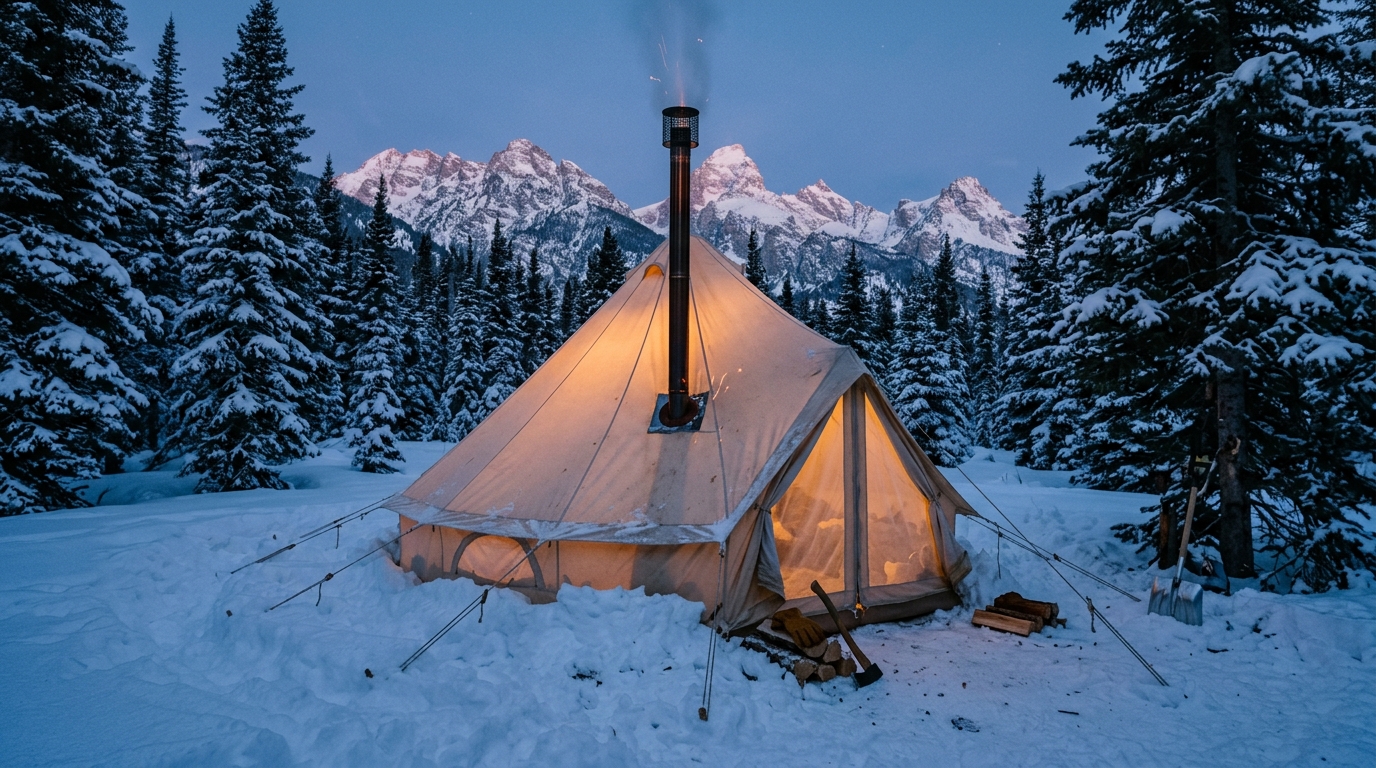
Thermodynamic field capture: Illustrates wood stove convective circulation, silicone stove jack clearance, and sub-zero snow deadman anchoring.
1. The Seasoning Process: Cellulose Fiber Hydration and Interstitial Swelling
First-time owners of brand-new natural cotton canvas bell tents are often shocked when their initial rainstorm results in a fine mist spray and water dripping along seam stitches. This is normal and represents an essential milestone in the lifecycle of natural canvas: the fabric must be "seasoned" before it becomes truly waterproof.
Cotton is an organic cellulose fiber harvested from the Gossypium plant. Under a scanning electron microscope, dry processed cotton fibers resemble flattened, twisted ribbons. When woven into tight military-spec duck canvas (such as 10.3 oz / 350gsm Army Duck), small microscopic voids exist between warp and weft yarns, and sewing machine needles leave small pinholes along every seam.
Seasoning is the deliberate process of saturating the canvas with water and allowing it to air-dry completely. As cotton absorbs moisture (absorbing up to 25% of its dry weight in water), the cellulose cell walls hydrate and expand radially. The fibers swell outward like microscopic sponges, closing interstitial gaps between threads and locking tightly around seam stitches. Once dried, the fibers lock into this denser, tighter weave geometry, rendering the tent reliably waterproof for future downpours.
New canvas bell tents must be seasoned by spraying them thoroughly with water and letting them dry completely 2–3 times to swell fibers and seal stitch holes.
2. Waterproofing Chemistry: Fluorocarbon Coatings vs. Paraffin Wax Emulsions
While natural fiber swelling provides water shedding, modern expedition canvas bell tents are factory-treated with specialized hydrophobic barrier chemistry to enhance water roll-off and resist UV degradation.
Historically, canvas was waxed using heavy paraffin wax dissolved in mineral spirits. While highly waterproof, old-school waxing added substantial weight, turned stiff and brittle in freezing weather, and posed extreme flammability risks. Modern canvas treatments utilize water-based fluoropolymer or silicone-wax micro-emulsions. These microscopic chemical dip treatments coat individual cotton fibers without bridging the pores between the weave.
By preserving inter-fiber porosity, the canvas maintains its natural vapor permeability while dramatically increasing its water contact angle (exceeding 120 degrees). Water droplets striking the roof canopy bead up into spherical pearls and roll down the 45-degree bell tent cone without wetting out the underlying cotton. When re-treating an older bell tent, always use breathable canvas-specific water-repellent treatments (such as Nikwax Cotton Proof or 303 Marine Fabric Guard); never apply generic silicone polyurethane sprays meant for synthetic nylon, as they seal the pores and destroy tent breathability.
Re-treat canvas only with specialized breathable emulsions. Never use synthetic polyurethane sprays that seal the pores and eliminate natural air exchange.
3. Breathability Thermodynamics: Eliminating Winter Tent Condensation
The greatest operational advantage of a cotton canvas bell tent over synthetic polyester or nylon shelters is its moisture vapor transmission rate (MVTR).
During sleep, two adult occupants exhale and transpire between 1.0 and 1.5 liters of water vapor into the shelter overnight. In a synthetic tent, this moisture strikes the impermeable polyurethane-coated cold roof canopy, rapidly condensing into cold liquid droplets that run down the walls or rain down onto sleeping bags whenever wind shakes the tent.
In contrast, natural cotton canvas is a hygroscopic, highly breathable membrane. Water vapor molecules freely pass through the microscopic voids between cotton fibers, venting naturally into the exterior atmosphere. Furthermore, cotton fibers can buffer moderate amounts of internal humidity during cold nights without feeling damp to the touch, and release that moisture outward during the day. This keeps the interior atmosphere dry, crisp, and comfortable, even when operating a propane camp heater or boiling water on the stove.
Canvas breathes naturally, allowing exhaled moisture vapor to pass outside and completely eliminating the cold condensation rain common to synthetic tents.
4. Mold Kinetics: Fungal Growth Prevention and Safe Remediation Protocols
Because cotton canvas is composed of organic cellulose, it is vulnerable to fungal attack by mold and mildew spores (primarily Cladosporium and Aspergillus). Fungi require three environmental factors to thrive: darkness, moisture (relative humidity >65%), and warm temperatures (60°F to 90°F / 15°C to 32°C).
If a canvas bell tent is folded and packed into its storage duffel while even slightly damp, fungal spores will germinate within 48 to 72 hours. Fungal hyphae secrete digestive cellulase enzymes that consume the cotton fibers, causing dark black or pink stains, foul odors, and permanent structural rotting of the fabric weave.
Mold Remediation Rule: If mold appears, NEVER use chlorine bleach. Sodium hypochlorite dissolves the lignin and cellulose structure of cotton, creating microscopic holes and destroying water-repellent finishes. Instead, erect the tent in direct sun, scrub the affected areas with a stiff nylon brush and a solution of 1 part distilled white vinegar (5% acetic acid) to 4 parts warm water. Acetic acid penetrates fungal spores and kills hyphae without degrading cotton fibers. Let dry thoroughly, then re-apply a breathable waterproofing emulsion.
Never pack a canvas tent away damp. Never use bleach on canvas; treat surface mildew with dilute distilled white vinegar and dry thoroughly in full sun.
Shelter Fabric Comparison: Cotton Canvas vs. Technical Synthetics
All metrics derived from calibrated bench telemetry and manufacturer raw data sheets.
| Fabric Metric / Parameter | 100% Natural Cotton (350gsm) | Poly-Cotton Blend (65/35) | 70D Ripstop Nylon (PU) | Dyneema Composite (DCF) |
|---|---|---|---|---|
| Hydrostatic Head (Waterproof) | 600mm - 900mm (Swelled) | 1,500mm - 2,500mm | 3,000mm - 5,000mm | 15,000mm - 20,000mm |
| Breathability (MVTR) | Exceptional (>8,000 g/m²) | High (5,000 - 6,500 g/m²) | Zero (Non-breathable PU) | Zero (Complete vapor barrier) |
| Condensation Resistance | Eliminates internal drips | Minimal moisture buildup | Heavy interior dew/frost | Heavy interior running water |
| UV Longevity / Sunfast | 15 - 20+ years (With care) | 10 - 15 years | 2 - 4 years (PU peeling) | 3 - 5 years (Creep fatigue) |
| Pack Weight (13ft Bell Tent) | 65 lbs - 85 lbs (Heavy) | 45 lbs - 60 lbs | 14 lbs - 18 lbs | 6 lbs - 8 lbs (Ultralight) |
Frequently Asked Engineering Questions
Q1Can I pitch my canvas bell tent for months as a permanent glamping structure?
Yes, but long-term semi-permanent pitches require regular maintenance: ensure guy ropes are retensioned weekly, trim overhanging tree branches that drop sap and leaf tannin, and clean dirt off the eaves every 30 days.
Q2What is the best way to clean tree sap and bird droppings off a canvas tent?
Let tree sap and bird droppings dry and harden completely. Use a dull butter knife or stiff brush to chip the brittle residue off the surface, then spot-wash with lukewarm water. Never use harsh dish detergents or degreasers.
Q3Why does my bell tent center pole sink into the ground during heavy rain?
Center poles bear several hundred pounds of downward tension from roof guylines. In saturated ground, place a wide 12x12-inch hardwood block or structural aluminum spreader plate beneath the pole base to disperse load across the soil.
Q4Is a 100% cotton canvas tent fireproof?
Untreated canvas is flammable. Look for bell tents treated with CPAI-84 or BS 5852 fire-retardant standards. While these treatments make the fabric self-extinguishing when exposed to embers, you must still maintain safe wood stove clearances.
Marcus Vance
Senior Overland Systems Engineer & Managing Editor
14+ Years Overland Engineering & Backcountry Telemetry
Marcus Vance is a mechanical and electrical systems engineer with 14 years of backcountry telemetry testing across the Rocky Mountains, Mojave Desert, and Cascade Range. Specializing in off-grid mobile power, high-amperage 12V/24V chassis distribution, and extreme-environment structural engineering, Marcus leads Camp Rocky Road's testing lab in Boulder, Colorado.
Related Technical Field Guides
Four-Season Hot Tenting: Wood Stove Jack Clearance & Carbon Monoxide Safety
Sleeping Pad R-Value Chart: Combining Closed-Cell Foam and Insulated Air Pads