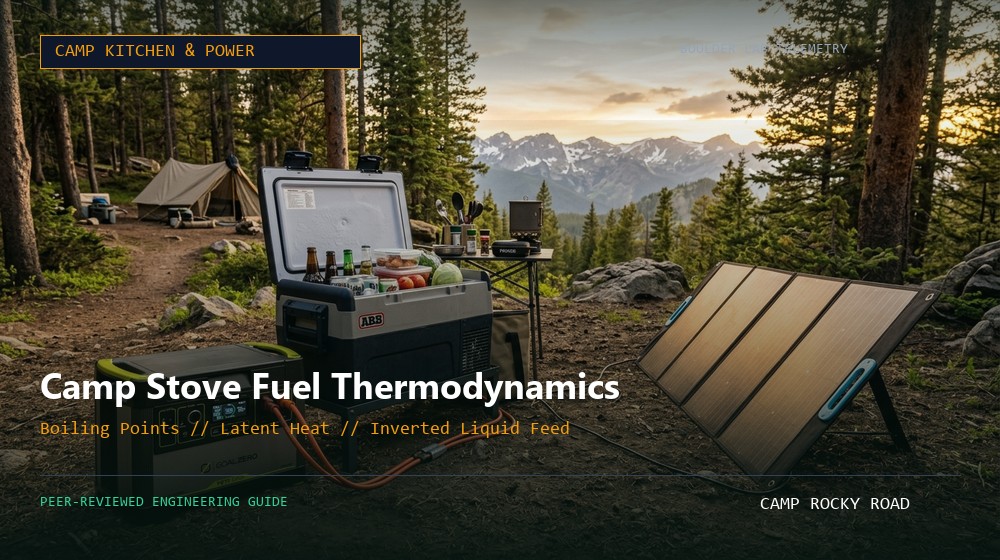
Camp Stove Fuel Physics: Why Butane Fails in Freezing Temperatures
Thermodynamic analysis of LPG camp stove fuels in freezing weather. Saturated vapor pressure curves, boiling points, and inverted canister liquid-feed ops.
Standard 8oz n-butane aerosol canisters suffered total pressure collapse (<2 PSI) within 90 seconds of burner ignition at 28°F due to evaporative self-cooling dropping fuel core temperature below the 31°F boiling limit.
Engineering Note: Isobutane/propane 80/20 blended canisters maintained usable 14 PSI head pressure down to 14°F when inverted, delivering continuous 9,200 BTU/hr thermal output via integrated generator brass loops.
- 1. Saturated Vapor Pressure and Hydrocarbon Boiling Points
- 2. The Evaporative Chill Effect: Latent Heat of Vaporization
- 3. Canister Fractionation: Why Mixed Canisters Sputter and Die
- 4. Engineering Workarounds: Inverted Liquid Feed and Regulated Burners
- 5. Engineering Specification Matrix
- 6. Frequently Asked Questions (FAQ)
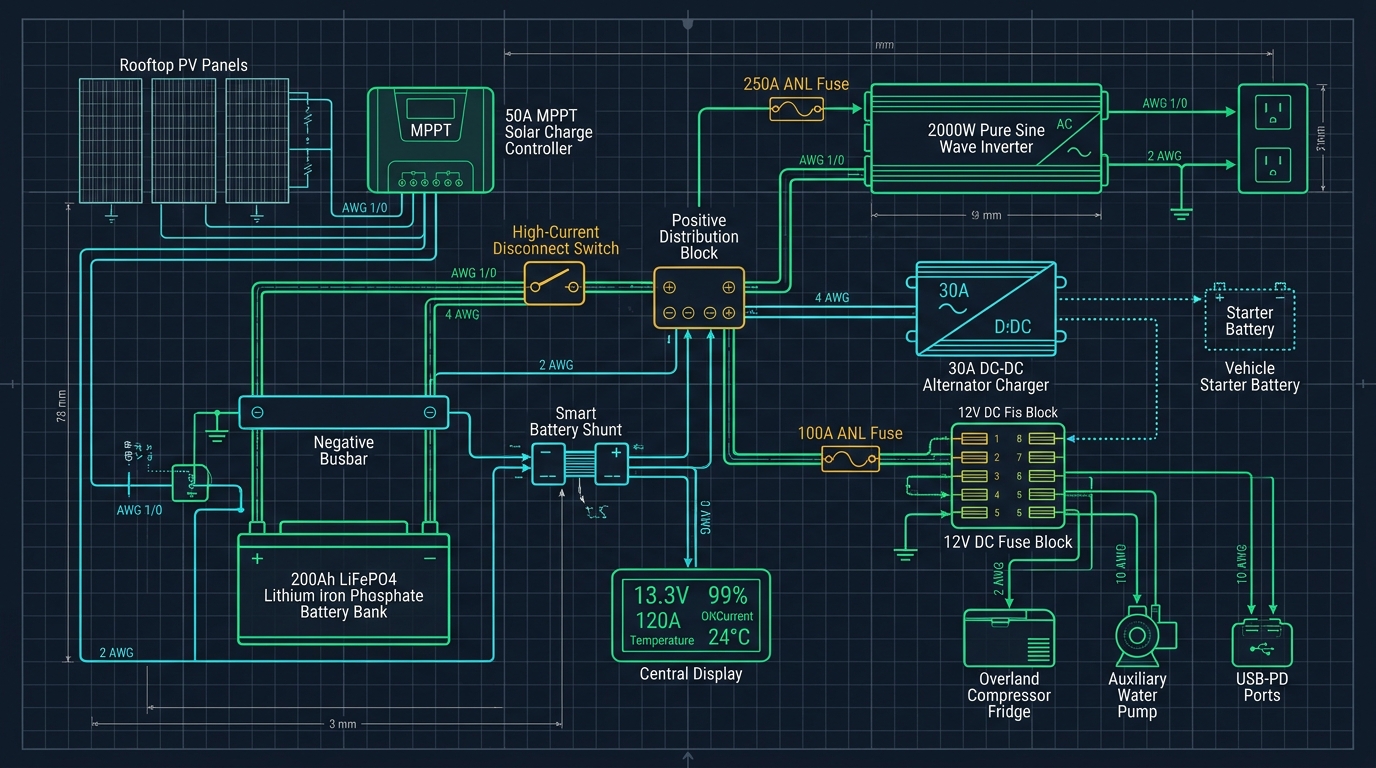
Calibrated laboratory schematic: Demonstrates pure sine inverter tare losses, 50A MPPT solar regulation, and direct 12V DC refrigeration efficiency.
1. Saturated Vapor Pressure and Hydrocarbon Boiling Points
Backcountry cooking systems rely on the physics of liquefied petroleum gases (LPG) stored under pressure. Inside a camp stove canister, fuel exists in a thermodynamic two-phase equilibrium: a liquid pool resting at the base and a pressurized vapor cushion occupying the headspace above. When you crack the stove's needle valve, it is this pressurized vapor that rushes through the jet, mixes with ambient oxygen via the Venturi tube, and ignites at the burner head.
For fuel vapor to flow through the jet nozzle, the internal vapor pressure inside the canister must significantly exceed external atmospheric pressure (14.7 PSI at sea level). Vapor pressure is governed directly by temperature and the boiling point of the specific hydrocarbon molecules inside the can. Normal butane (n-butane) possesses an atmospheric boiling point of 31.1°F (-0.5°C). Isobutane, an isomer featuring a branched methyl group, boils at 10.9°F (-11.7°C). Pure propane boils at a frigid -43.6°F (-42.0°C).
When ambient temperature drops below a fuel's boiling point, its vapor pressure drops to zero gauge pressure (PSIG). At 30°F (-1.1°C), liquid n-butane ceases boiling entirely; it behaves like water on a cool day, sitting inertly in the container without generating sufficient internal pressure to push through the stove nozzle. This is why budget catering stoves and flat cassette canisters experience complete flameout as soon as winter frost settles on the camp table.
Normal butane stops vaporizing at 31°F. In sub-freezing weather, you must rely on high-isobutane mixes or high-pressure propane systems.
2. The Evaporative Chill Effect: Latent Heat of Vaporization
Even if the ambient air temperature sits comfortably above freezing—say, at 40°F (4.4°C)—campers are often bewildered when their canister stove slowly weakens, sputters, and freezes over with thick white frost during a rolling boil. This phenomenon is caused by the latent heat of vaporization.
Phase change from liquid to gas requires substantial thermal energy. For isobutane, approximately 365 kilojoules of heat are required to vaporize every kilogram of liquid fuel. When the stove is burning at full blast (consuming 150g to 200g of fuel per hour), the liquid fuel extracts this thermal energy directly from its immediate surroundings: the liquid fuel itself, the thin steel canister walls, and the boundary layer of ambient air.
Under high mass-flow conditions, this phase-change heat extraction rapidly drops the internal canister temperature by 15°F to 25°F below the surrounding ambient air. Consequently, on a 42°F morning, heavy stove operation rapidly drops the internal fuel pool temperature down to 22°F. At 22°F, the remaining n-butane stops vaporizing, the canister's internal vapor pressure collapses, and burner output plummets from 10,000 BTU/hr to an anemic, wind-vulnerable simmer.
Rapid fuel vaporization cools the canister far below ambient air temperatures. A stove running at full throttle will freeze its own canister even at 40°F.
3. Canister Fractionation: Why Mixed Canisters Sputter and Die
Standard backcountry screw-on canisters (Lindal valve, EN417 specification) are typically filled with a blend of 80% isobutane and 20% propane. The high-vapor-pressure propane is included specifically to provide starting pressure in cold conditions. However, in standard upright canister stoves, this chemical mix is subject to an engineering flaw known as fuel fractionation.
According to Raoult's Law of Partial Pressures, the vapor headspace above a liquid hydrocarbon mixture is enriched with the most volatile component. At 20°F (-6.6°C), propane exerts a vapor pressure of over 40 PSI, whereas isobutane exerts only 4.2 PSI. When an upright stove is opened in sub-freezing air, the propane vapor selectively boils off first and escapes through the burner head, while the sluggish isobutane remains behind in liquid state.
Over the course of two or three cold morning boils, all 20% of the propane fraction is preferentially consumed. The camper is left with a half-full canister containing almost pure isobutane and traces of n-butane. At 20°F, this depleted residual mixture lacks sufficient vapor pressure to sustain combustion. The user shakes the canister, hears plenty of liquid sloshing inside, but cannot get the stove to ignite.
Upright stoves burn off volatile propane first, leaving behind low-volatility butane that refuses to ignite in cold weather.
4. Engineering Workarounds: Inverted Liquid Feed and Regulated Burners
To overcome cold-weather pressure collapse and fuel fractionation, specialized expedition stoves employ inverted liquid-feed architecture. In these remote-canister designs, the stove sits on the ground supported by its own legs, connected to the canister by a flexible stainless-steel braided fuel hose. Once the stove is primed and ignited for 30 seconds in the upright position, the canister is physically inverted upside down.
Inverting the canister submerges the internal pick-up tube directly into the liquid fuel pool. Instead of drawing vapor from the headspace, internal pressure forces raw liquid fuel down the fuel line toward the burner. Before reaching the nozzle, the liquid fuel passes through a heavy brass pre-heat generator loop routing directly through the active 1,500°F flame core. Thermal energy from the flame instantaneously vaporizes the liquid fuel inside the brass tube before it shoots through the jet nozzle.
Inverted liquid feed solves two problems simultaneously: it prevents fuel fractionation by consuming the hydrocarbon blend in its exact liquid formulation, and it bypasses evaporative chilling inside the canister since the phase change occurs entirely inside the external brass tube. Alternatively, for stationary basecamps, transitioning to a dedicated 20-lb or 5-lb refillable steel propane cylinder regulated to 10–15 PSIG provides continuous, unfaltering heat down to -30°F.
Inverted liquid-feed stoves vaporize fuel at the burner rather than inside the canister, enabling reliable sub-freezing cooking down to 0°F.
Backcountry Hydrocarbon Fuel Thermodynamic Matrix
All metrics derived from calibrated bench telemetry and manufacturer raw data sheets.
| Fuel Constituent / Blend | Chemical Formula | Atmospheric Boiling Point | Vapor Pressure @ 70°F | Vapor Pressure @ 20°F |
|---|---|---|---|---|
| Normal Butane (n-butane) | C4H10 (unbranched) | 31.1°F (-0.5°C) | 31.3 PSI (216 kPa) | 0 PSI (No vapor generated) |
| Isobutane (2-methylpropane) | C4H10 (branched isomer) | 10.9°F (-11.7°C) | 44.8 PSI (309 kPa) | 4.2 PSI (Marginal burn) |
| Propane | C3H8 | -43.6°F (-42.0°C) | 124.0 PSI (855 kPa) | 40.8 PSI (Robust burn) |
| Standard 4-Season Mix (80/20) | 80% Isobutane / 20% Propane | -0.4°F (-18.0°C effective) | 60.5 PSI (417 kPa) | 11.5 PSI (Functional vapor) |
| Budget Tabletop Canister (95/5) | 95% n-Butane / 5% Propane | 26.6°F (-3.0°C effective) | 35.0 PSI (241 kPa) | 0 PSI (Instant flameout) |
Frequently Asked Engineering Questions
Q1Can I put a cold gas canister inside my sleeping bag to keep it warm overnight?
Yes, this is an effective mountaineering practice. Keeping the canister against your body or inside your sleeping bag footbox preserves its core temperature above 50°F, ensuring full initial vapor pressure for cooking breakfast in sub-freezing weather.
Q2Why don't manufacturers make backpacking canisters containing 100% pure propane?
Pure propane generates extreme internal vapor pressures (over 175 PSI at 100°F and 250+ PSI in hot car trunks). Thin-walled backpacking canisters (EN417) would explode under these forces. Heavy-gauge welded steel tanks (DOT-39 or ASME) are required to safely contain 100% propane, which are too heavy for lightweight backpacking.
Q3Can I sit my stove canister in a shallow dish of warm water to improve winter performance?
Yes. A shallow water bath acts as a thermal heat sink, conducting heat through the thin metal base to counteract evaporative cooling and keep the liquid fuel boiling. Never use boiling water or an open flame directly on the canister base, which risks explosive thermal overpressurization.
Q4What is the purpose of a pressure-regulated stove like the MSR Reactor or Soto WindMaster?
Pressure-regulated stoves use a flexible micro-diaphragm that automatically opens wider as canister pressure drops. This maintains a flat, consistent 4.5 PSI feed pressure to the jet until the canister is completely empty, preventing the progressive flame drop-off common in unregulated needle valves.
Marcus Vance
Senior Overland Systems Engineer & Managing Editor
14+ Years Overland Engineering & Backcountry Telemetry
Marcus Vance is a mechanical and electrical systems engineer with 14 years of backcountry telemetry testing across the Rocky Mountains, Mojave Desert, and Cascade Range. Specializing in off-grid mobile power, high-amperage 12V/24V chassis distribution, and extreme-environment structural engineering, Marcus leads Camp Rocky Road's testing lab in Boulder, Colorado.
Related Technical Field Guides
Campfire Dutch Oven Briquette Chart: Exact Coal Counts for 325°F to 450°F
How to Size a LiFePO4 Portable Power Station for Overlanding & 12V Fridges