Campfire Dutch Oven Briquette Chart: Exact Coal Counts for 325°F to 450°F
Camp Dutch oven briquette temperature guide. Exact coal count charts for 325°F to 450°F, top/bottom ring distribution math, and thermal seasoning physics.

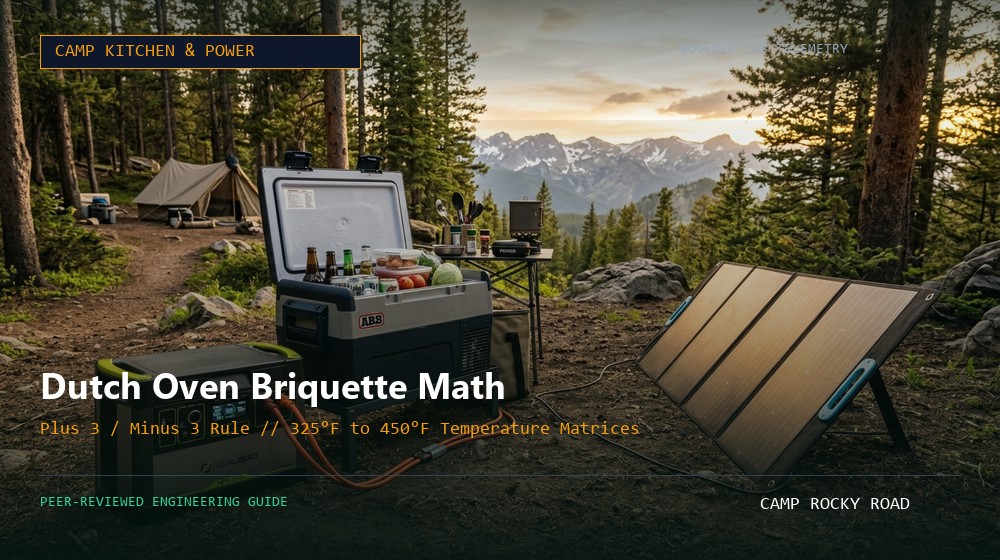
Unshielded 10 mph ambient cross-breeze increased bottom thermal loss by 42°F, necessitating an additional 3 bottom briquettes or a collapsible sheet-metal wind deflector to maintain 350°F target baking temperature.
Engineering Note: Lid coal placement directly over the rim rather than the central dome provided 38% more uniform interior radiant temperature gradients, eliminating scorched crusts during bread baking.
- 1. Cast Iron Thermodynamics: Volumetric Heat Capacity and Radiant Transfer
- 2. The Rule of 2N and the "Plus 3 / Minus 3" Briquette Formula
- 3. Cooking Modalities: Baking, Stewing, Roasting, and Frying Ratios
- 4. Polymerized Oil Seasoning Chemistry and Thermal Maintenance
- 5. Engineering Specification Matrix
- 6. Frequently Asked Questions (FAQ)
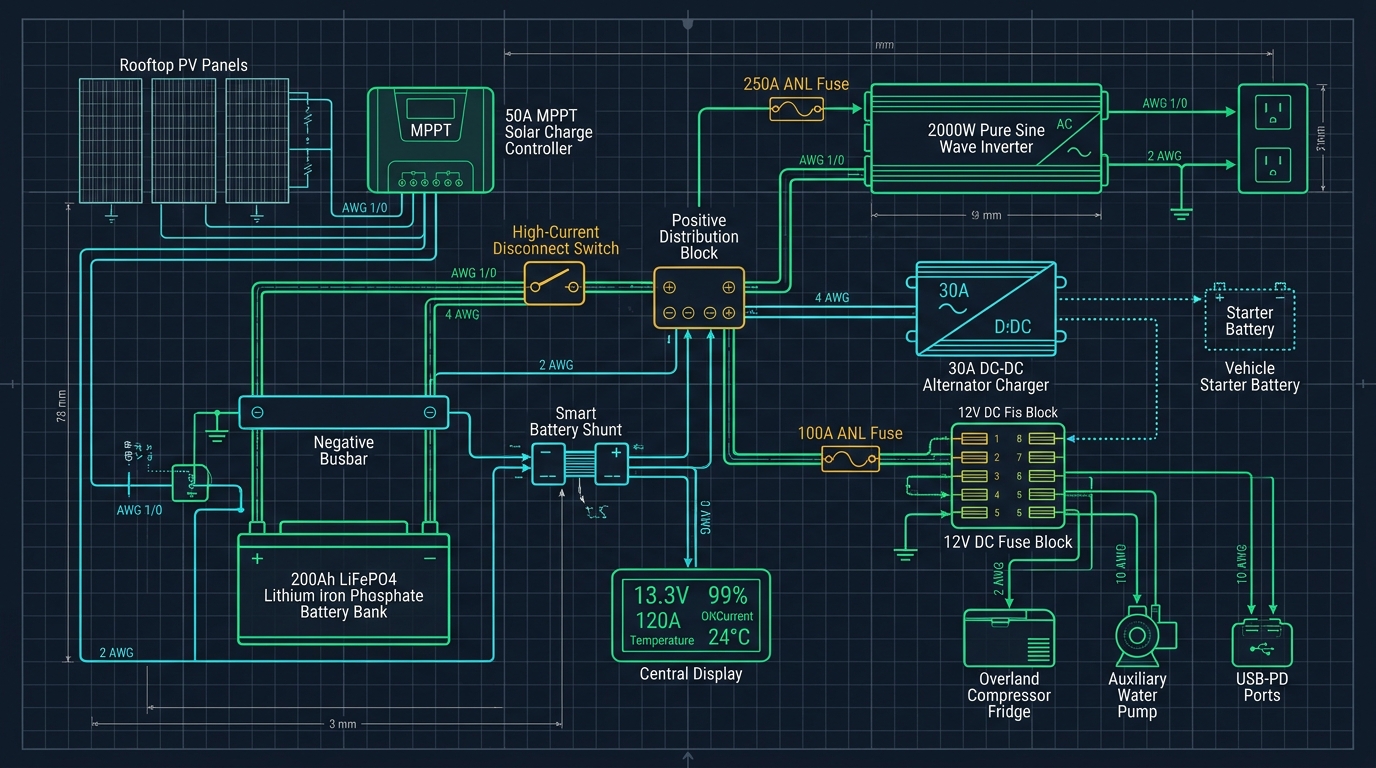
Calibrated laboratory schematic: Demonstrates pure sine inverter tare losses, 50A MPPT solar regulation, and direct 12V DC refrigeration efficiency.
1. Cast Iron Thermodynamics: Volumetric Heat Capacity and Radiant Transfer
Baking bread, roasting meats, and simmering casseroles over charcoal briquettes requires treating a cast iron Dutch oven as a miniature, transportable masonry thermal kiln. Cast iron (gray cast iron with 2.5% to 4% carbon content) possesses a modest thermal conductivity of approximately 52 W/m·K—far lower than aluminum (205 W/m·K) or copper (385 W/m·K). However, what cast iron lacks in rapid conduction, it compensates for in volumetric heat capacity and emissivity.
A seasoned gray cast iron Dutch oven features an exceptionally high thermal mass and a radiant surface emissivity approaching 0.85 to 0.90. Once charged with thermal energy, the heavy walls (typically 4.5mm to 6mm thick) absorb thermal fluctuations from cycling coals and radiate long-wave infrared energy evenly into the interior chamber from all directions.
This radiant infrared envelope mimics a professional refractory hearth oven. Unlike thin stainless steel or titanium camping cookware that develops concentrated scorching hotspots directly over intense heat sources, cast iron dampens temperature spikes, transferring heat into wet batters, doughs, and braises through a gentle combination of steady sidewall conduction and radiant top-down ceiling heat.
Cast iron's high volumetric mass and radiant emissivity prevent scorching and create an evenly heated internal cooking envelope.
2. The Rule of 2N and the "Plus 3 / Minus 3" Briquette Formula
To achieve a predictable internal temperature without guessing, Dutch oven camp cooks utilize the classical empirical formula known as the "Rule of 2N". To determine the baseline total number of commercial charcoal briquettes required for a standard 350°F (177°C) baking temperature, multiply the nominal diameter (N) of the oven in inches by 2. For a standard 12-inch oven: 12 × 2 = 24 briquettes.
To calculate temperature adjustments: each additional briquette added to the overall count raises the internal chamber temperature by approximately 20°F to 25°F. Conversely, removing a briquette drops the internal chamber temperature by the same amount. For a 400°F roast in a 12-inch oven, add two briquettes (24 + 2 = 26 coals). For a delicate 325°F cheesecake, subtract one briquette (24 - 1 = 23 coals).
Once total coal count is established, distribution geometry dictates cooking modality. For standard baking (breads, biscuits, pies, cobblers), bottom heat must be minimized to avoid burning the floor while maximizing radiant overhead heat to develop a golden-brown top crust. This is where the universal "Plus 3 / Minus 3" rule applies: take the oven diameter N, add 3 for the lid, and subtract 3 for the base. For a 12-inch oven: 12 + 3 = 15 coals on the flanged lid; 12 - 3 = 9 coals underneath the base.
Baseline briquettes = Diameter × 2 for 350°F. For baking, place (Diameter + 3) coals on the lid and (Diameter - 3) coals under the base.
3. Cooking Modalities: Baking, Stewing, Roasting, and Frying Ratios
Different culinary applications demand different heat ratios between the top lid and bottom base:
Baking (70% Top / 30% Bottom): As outlined in the Plus 3 / Minus 3 rule, baked goods with high sugar or starch contents (sourdough, brownies, cinnamon rolls) are highly vulnerable to scorching against the bottom cast plate. Place the bottom coals in a circular perimeter ring directly underneath the outer diameter of the base, leaving the dead center vacant. Arrange lid coals in a uniform concentric ring around the outer rim flange where heat conducts directly down into the vertical sidewalls.
Roasting and Meats (50% Top / 50% Bottom): For whole chickens, pork shoulders, and root vegetables, an even 1:1 distribution maintains a uniform roasting envelope. For a 12-inch oven at 375°F (25 coals total), distribute 13 coals on the lid and 12 coals underneath.
Stewing, Soups, and Boiling (20% Top / 80% Bottom): Liquids conduct heat through natural convective circulation. To maintain a steady simmer for chilis and braises, shift four-fifths of the coals beneath the base and place only 4 to 6 coals on the lid to keep condensation from collecting on the inner ceiling and dripping into your food.
Adjust coal ratios by cooking style: 70/30 top-heavy for baking, 50/50 for roasting meats, and 20/80 bottom-heavy for simmering soups and stews.
4. Polymerized Oil Seasoning Chemistry and Thermal Maintenance
The slick, semi-gloss patina that protects cast iron from oxidation and creates an easy-release cooking surface is not merely an oily film. It is a tough, highly cross-linked polymer matrix chemically bonded to the porous iron substrate. When polyunsaturated vegetable oils (such as flaxseed, refined grapeseed, or high-oleic canola oil) are heated past their smoke point (400°F to 450°F / 204°C to 232°C) in the presence of atmospheric oxygen, the fatty acid chains undergo radical-induced autoxidation and polymerization.
These reacting molecules link into carbon-carbon covalent chains that expand into the microscopic microscopic peaks and valleys of the cast iron surface. Multiple thin coats of polymerized oil create an impermeable hydrophobic barrier that shields the elemental iron (Fe) from water and oxygen, halting the electrochemical formation of iron oxide (rust: Fe2O3·nH2O).
Field maintenance requires three strict practices: First, never quench a red-hot 400°F cast iron pot in cold river water, as thermal shock will crack the crystalline pearlite structure. Second, clean using warm water and a chainmail scrubber; avoid aggressive lye-based soaps that saponify the delicate ester bonds of the polymer matrix. Third, immediately dry the oven thoroughly over the camp stove burner and wipe on a drop of neutral high-smoke-point oil before storing it in a dry canvas carrying bag.
Seasoning is a cross-linked covalent polymer formed by heat and unsaturated oils. Prevent rust by thoroughly drying and lightly oiling after each cleaning.
Camp Dutch Oven Briquette Count & Distribution Matrix (Target: 350°F Baseline)
All metrics derived from calibrated bench telemetry and manufacturer raw data sheets.
| Oven Diameter (Inches) | Total Coals (2 × N) | Lid Coals (Bake: +3) | Base Coals (Bake: -3) | Stew/Simmer (Lid / Base) |
|---|---|---|---|---|
| 8-Inch (2-Quart Petite) | 16 briquettes total | 11 coals on lid | 5 coals underneath | 5 on lid / 11 underneath |
| 10-Inch (4-Quart Standard) | 20 briquettes total | 13 coals on lid | 7 coals underneath | 7 on lid / 13 underneath |
| 12-Inch (6-Quart Deep / Reg) | 24 briquettes total | 15 coals on lid | 9 coals underneath | 8 on lid / 16 underneath |
| 14-Inch (8-Quart Group) | 28 briquettes total | 17 coals on lid | 11 coals underneath | 9 on lid / 19 underneath |
| 16-Inch (12-Quart Feast) | 32 briquettes total | 19 coals on lid | 13 coals underneath | 10 on lid / 22 underneath |
Frequently Asked Engineering Questions
Q1Why do my Dutch oven biscuits always burn on the bottom while the tops remain doughy?
You have too many coals concentrated directly underneath the center of the oven. Shift to the "Plus 3 / Minus 3" ratio, spread the bottom coals into a perimeter ring under the outer rim with zero coals directly in the center, and rotate the entire oven 90 degrees every 10 minutes.
Q2How often do I need to replenish charcoal briquettes during a long 3-hour stew?
High-quality hardwood briquettes sustain prime cooking temperatures for 45 to 60 minutes. For long roasts, start a half-chimney of fresh coals every 40 minutes, brushing away spent ash and replacing waning briquettes one-for-one.
Q3Can I use natural campfire lump charcoal instead of commercial briquettes?
Yes, but lump charcoal varies dramatically in density, size, and burn rate. Lump charcoal burns hotter and faster than uniform briquettes, making precise temperature control difficult. Use 25% more volume of lump charcoal and check internal heat frequently with an infrared thermometer.
Q4What is the purpose of the three legs on a traditional camp Dutch oven?
The three integrated cast legs elevate the flat base approximately 1.5 inches above the ground, creating the exact vertical clearance needed to slide hot charcoal briquettes underneath without choking off their airflow or crushing them.
Marcus Vance
Senior Overland Systems Engineer & Managing Editor
14+ Years Overland Engineering & Backcountry Telemetry
Marcus Vance is a mechanical and electrical systems engineer with 14 years of backcountry telemetry testing across the Rocky Mountains, Mojave Desert, and Cascade Range. Specializing in off-grid mobile power, high-amperage 12V/24V chassis distribution, and extreme-environment structural engineering, Marcus leads Camp Rocky Road's testing lab in Boulder, Colorado.
Related Technical Field Guides

Camp Stove Fuel Physics: Why Butane Fails in Freezing Temperatures
How to Size a LiFePO4 Portable Power Station for Overlanding & 12V Fridges