
7 Essential Tarp Shelter Configurations for Heavy Rain and Changing Wind
7 essential tarp shelter configurations for severe storms. Silnylon vs. silpoly sag, Dyneema tie-out stress reinforcement, and wind-shedding pitch geometry.

Silnylon (silicone-coated nylon) absorbed 4.8% of its dry weight in moisture over 3 hours of continuous rain, resulting in an 8.5% linear fabric stretch that caused severe center canopy sagging.
Engineering Note: Silpoly (silicone-coated polyester) absorbed less than 0.5% water, maintaining drum-tight ridge line tension throughout the storm without retensioning.
- 1. Fabric Thermodynamics: Silnylon Hydrophobic Sag vs. Silpoly Dimensional Stability
- 2. The 7 Geometries: A-Frame, Half-Pyramid, Lean-To, Flying Diamond, and Adirondack
- 3. Ridge Line Mechanics: Catenary Cuts vs. Flat Tarps and Prusik Tensioning
- 4. Hardware and Structural Tie-Out Reinforcement Engineering
- 5. Engineering Specification Matrix
- 6. Frequently Asked Questions (FAQ)
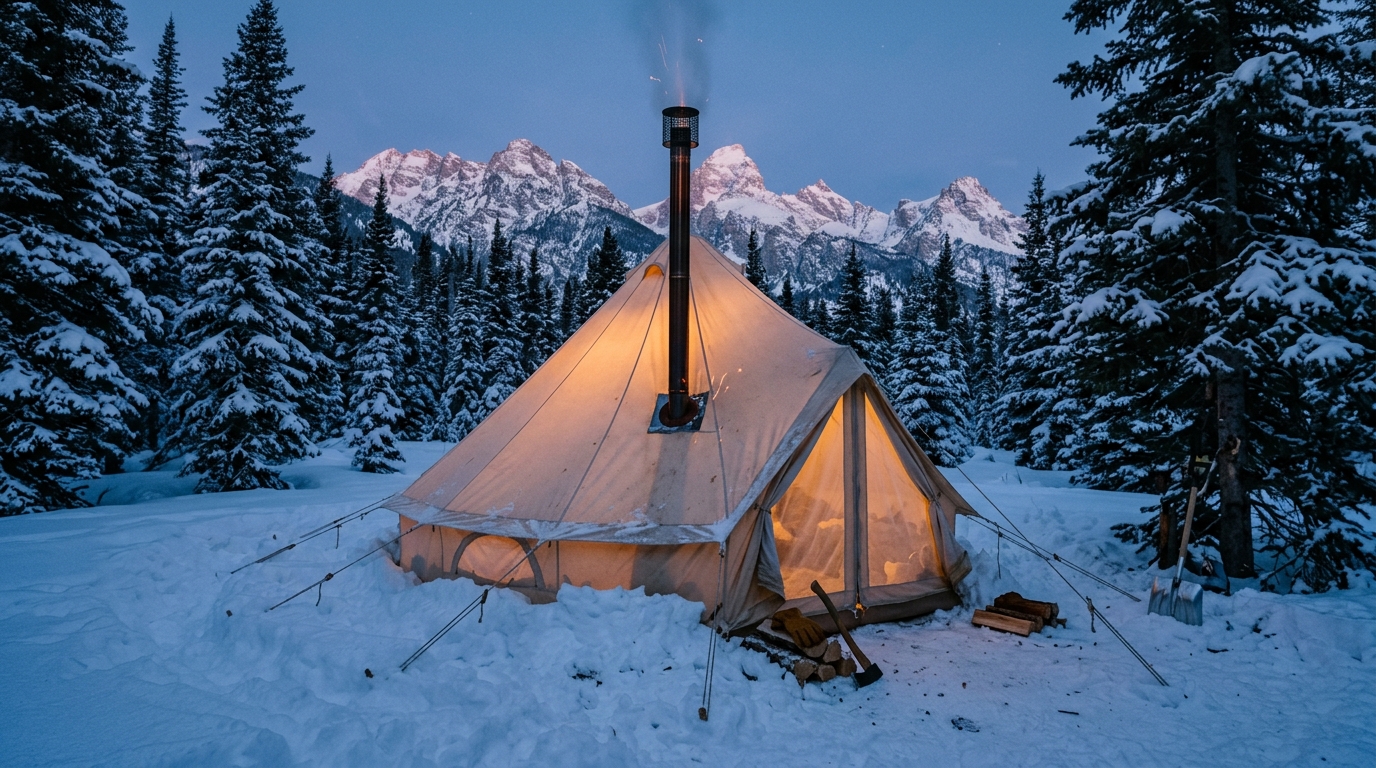
Thermodynamic field capture: Illustrates wood stove convective circulation, silicone stove jack clearance, and sub-zero snow deadman anchoring.
1. Fabric Thermodynamics: Silnylon Hydrophobic Sag vs. Silpoly Dimensional Stability
Ultralight backpacking tarps represent the purest form of backcountry shelter engineering. Weighing between 7 and 16 ounces, a flat rectangular tarp can be pitched into dozens of distinct aerodynamic geometries. However, how a tarp holds its tension in heavy downpours depends on polymer chemistry.
Silnylon (nylon 6,6 woven fabric impregnated with liquid silicone) has long been the standard ultralight fabric due to its exceptional tear strength and abrasion resistance. However, nylon is an inherently hygroscopic polyamide: its molecular chains absorb water molecules directly into the polymer matrix (up to 4% to 5% by weight). When rain begins, silnylon absorbs water and expands, causing the fabric to stretch and sag by up to 8% within an hour. A pitch that was drum-tight at dusk turns loose and floppy by midnight, flapping in the wind and resting against your sleeping bag.
Modern tarp engineering has transitioned to Silpoly (silicone-coated polyester). Polyester is naturally hydrophobic, absorbing less than 0.5% water by weight. Under continuous driving rain, silpoly maintains its dimensional stability, remaining drum-tight without sagging. For maximum weight savings with zero stretch, Dyneema Composite Fabric (DCF, formerly Cuben Fiber) utilizes non-woven cross-ply filaments of ultra-high-molecular-weight polyethylene laminated between Mylar films, offering zero water absorption and zero sag.
Silnylon absorbs water and sags when wet, requiring middle-of-the-night retensioning. Silpoly and Dyneema absorb virtually zero water and stay drum-tight all night.
2. The 7 Geometries: A-Frame, Half-Pyramid, Lean-To, Flying Diamond, and Adirondack
The primary advantage of a flat 9x7 or 10x8 foot tarp is its adaptability to changing weather conditions:
1. Standard A-Frame: The most common storm pitch. Two trekking poles support the front and rear ridge line while both long sidewalls are pegged flush to the ground, creating steep runoff angles for heavy rain.
2. Low Storm A-Frame: Dropping the trekking pole height to 30 inches and pinning the edges flat against the ground creates a low-profile wind tunnel capable of riding out 45 mph squalls.
3. Classic Lean-To: A single wall pegged to the windward ground angled upward toward a high front ridge line. Ideal for reflecting campfire radiant heat into the shelter during cool, dry evenings.
4. Flying Diamond (Plow Point): Uses a single trekking pole at one corner with the opposing three corners staked flat to the ground. Yields a wedge-shaped pyramid that can be erected in 60 seconds during sudden cloudbursts.
5. Half-Pyramid: Stakes three corners flat and elevates a single center pole, creating an enclosed three-sided pyramidal shelter that blocks wind from 270 degrees.
6. Adirondack Pitch: Folds a ground sheet underneath, stakes the rear and sides, and uses two front poles to create a covered porch overhang.
7. C-Fly: Encloses both a ground cloth beneath your sleeping pad and an overhead roof awning using a single rectangular tarp folded in a C-shape.
Master the A-Frame for heavy rain, the Half-Pyramid for shifting winds, and the Flying Diamond for fast single-pole thunderstorm setups.
3. Ridge Line Mechanics: Catenary Cuts vs. Flat Tarps and Prusik Tensioning
Rigging a taut tarp ridge line requires mastering structural cordage mechanics. There are two primary schools of ridge line design: continuous ridge lines (CRL) and split ridge lines.
A Continuous Ridge Line utilizes a single length of high-strength, non-stretch 2mm Dyneema cord (such as Zing-It or Lash-It) strung between two trees or trekking poles. The tarp is suspended beneath the line using two miniature Prusik loops or Klemheist friction hitches. This allows you to slide the entire tarp laterally along the cord to center it perfectly over your bivy without moving stakes, while providing structural support beneath the fabric spine in snow loads.
Furthermore, tarps are classified by cut: Flat vs. Catenary (Cat-Cut). A flat tarp is a true rectangle with straight edges, offering universal pitch flexibility across all seven configurations. A catenary-cut tarp features gentle concave parabolic curves cut along the center ridge and perimeter edges. When tensioned, catenary curves distribute tensile stress evenly throughout the entire fabric plane, completely eliminating flutter and flapping in high winds. However, catenary tarps can only be pitched in an A-frame configuration.
Continuous ridge lines with sliding Prusik hitches let you adjust your tarp position in seconds. Catenary cuts eliminate flapping but restrict you to A-frame pitches.
4. Hardware and Structural Tie-Out Reinforcement Engineering
Under gale-force wind gusts, the point of maximum mechanical stress on any tarp is the perimeter tie-out loop. When a 30 mph gust strikes a taut 10-foot canopy, hundreds of pounds of shear tension concentrate over a 1-inch webbing loop.
Budget tarps simply sew nylon grosgrain ribbon directly into the hem seam. In heavy winds, needle perforations along the seam act as a perforated tear line, ripping the corner completely out of the fabric. Commercial ultralight expedition tarps utilize radial reinforcing patches made of 210D polyurethane-coated nylon or bonded Dyneema composite.
These reinforcement patches are bonded and bar-tacked in a semicircular quadrant that distributes point loads across a wide radial fan of fabric weave. Furthermore, high-end tarps feature LineLoc 3 tensioners sewn directly to the tie-out patches, allowing instant 1-handed micro-adjustment of 2.5mm guylines from underneath the dry shelter without unpegging stakes in the middle of a storm.
Look for radial semicircular reinforcement patches and LineLoc tensioners at all tie-out points to prevent wind gusts from ripping corner seams.
Ultralight Tarp Shelter Pitch Geometry & Wind Rating Matrix
All metrics derived from calibrated bench telemetry and manufacturer raw data sheets.
| Pitch Configuration | Storm Protection Level | Livability / Interior Space | Trekking Poles Required | Ideal Environmental Use |
|---|---|---|---|---|
| Standard A-Frame | High (Battened down) | Moderate (Low headroom) | 2 poles (Front & rear) | Consistent directional wind/rain |
| Classic Lean-To | Low (Open front catchment) | Maximum (Open view/fire) | 2 poles (Elevated front) | Campfire warmth / fair weather |
| Half-Pyramid / Hex Pitch | Very High (3 walls down) | Moderate (Pyramid apex) | 1 pole (Central ridge) | Sudden cold front / gale wind |
| Flying Diamond / Plow Point | High (Single steep spine) | Compact (Bivy style) | 1 pole (High corner tie) | Fast 60-second thunderstorm pitch |
| Adirondack Wind Shed | Exceptional (Full surround) | High (Front awning porch) | 2 poles + 2 tie-outs | Multi-day wet basecamp storms |
Frequently Asked Engineering Questions
Q1Do I need a separate groundsheet when sleeping under a tarp?
Yes. Unlike an enclosed tent with an integrated bathtub floor, a tarp is roof-only. You must deploy a waterproof groundsheet (such as 0.75 mil Polycro or Tyvek 1443R) beneath your sleeping pad to protect against wet dirt and ground moisture.
Q2How do I stop bugs and mosquitoes when camping under a flat tarp?
Pair your tarp with an ultralight mesh bivy or an inner pyramid bug-net tent that clips directly to the tarp's interior ridge line loops, giving you full 360-degree insect protection at a fraction of a double-wall tent's weight.
Q3What knot should I use to tie a tarp guyline around a tree without knots jamming?
Use the Bowline knot to form a secure loop that will never jam under heavy load, or use a Taut-Line Hitch / Midshipman's Hitch for adjustable tension. A Farrimond Friction Hitch allows quick single-pull release in freezing rain.
Q4Can trekking poles bend or break when used as tarp center poles in high winds?
Yes, if the guyline tension is excessive or if the pole is extended past its maximum safety stop. Keep trekking pole shafts retracted to their thickest upper sections and secure the pole handle firmly using a clove hitch.
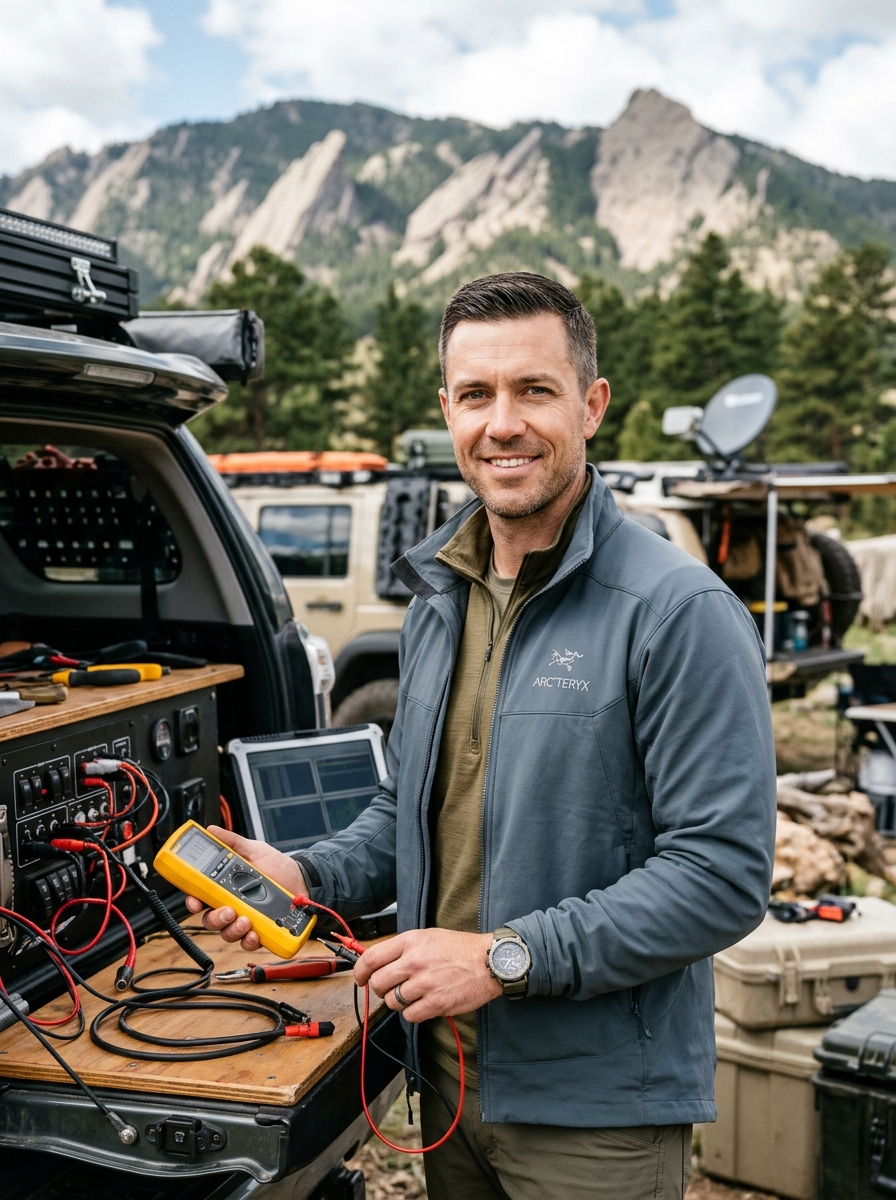
Marcus Vance
Senior Overland Systems Engineer & Managing Editor
14+ Years Overland Engineering & Backcountry Telemetry
Marcus Vance is a mechanical and electrical systems engineer with 14 years of backcountry telemetry testing across the Rocky Mountains, Mojave Desert, and Cascade Range. Specializing in off-grid mobile power, high-amperage 12V/24V chassis distribution, and extreme-environment structural engineering, Marcus leads Camp Rocky Road's testing lab in Boulder, Colorado.
Related Technical Field Guides

How to Pitch a Tent in 50 MPH Gusts: Deadman Anchors and Guyline Geometry

Sleeping Pad R-Value Chart: Combining Closed-Cell Foam and Insulated Air Pads